
Animation craft7 min read16 min video
Everything is free now. Somebody still pays for it.
Free vs Paid Animation Rigs: What Dozens of Creators Told Me

Key takeaways
- Talking to dozens of creators while building Animworks, one theme kept coming up: everything is expected to be free, so the people making rigs, courses and plugins can't earn from them.
- There used to be only a handful of animation rigs everyone used. Schools like Animation Mentor made professional rigs a perk worth paying for.
- Auto rigging made everyone a rigger. Plenty of free rigs look great and fall apart the moment you push a pose.
- A professional rig for $15 to $20 makes your showreel better and your life easier.
- Paying creators keeps them creating, and the whole community gets better work.
I’ve been building Animworks for over a year: a marketplace and community for animation rigs, courses and all kinds of valuable knowledge and assets. While building it, I talked with dozens of creators: riggers, technical animators, teachers, the people behind the tools you use every day.
They all had one theme in common, and it’s been on my mind ever since. Everything nowadays seems to be free, and that includes animation rigs.
So let’s talk about the price of free in the animation community: how things were when I started, how we got here, and why I think we should go back a little.
The real cost of free animation rigs
If you’re a creator, whether that’s an animator, game developer or designer, you eventually want to get paid for what you love. If you love building rigs, making courses or teaching others, your goal should be to get paid for that work.
But we’ve reached a point where the people making these things are dropping them for free, because they can’t see another way to make anything from them. The result is that people getting things free now expect everything to be free. When something costs even a little, there’s an outcry.
The people building for you are giving it away, because they don’t see another way.
We don’t talk about this much in the animation or games community. I think we should.
Where did the classic animation rigs come from?
Let me paint a picture of when I started, around 2002 and 2003. There were barely any rigs online, and finding a good one was almost impossible.
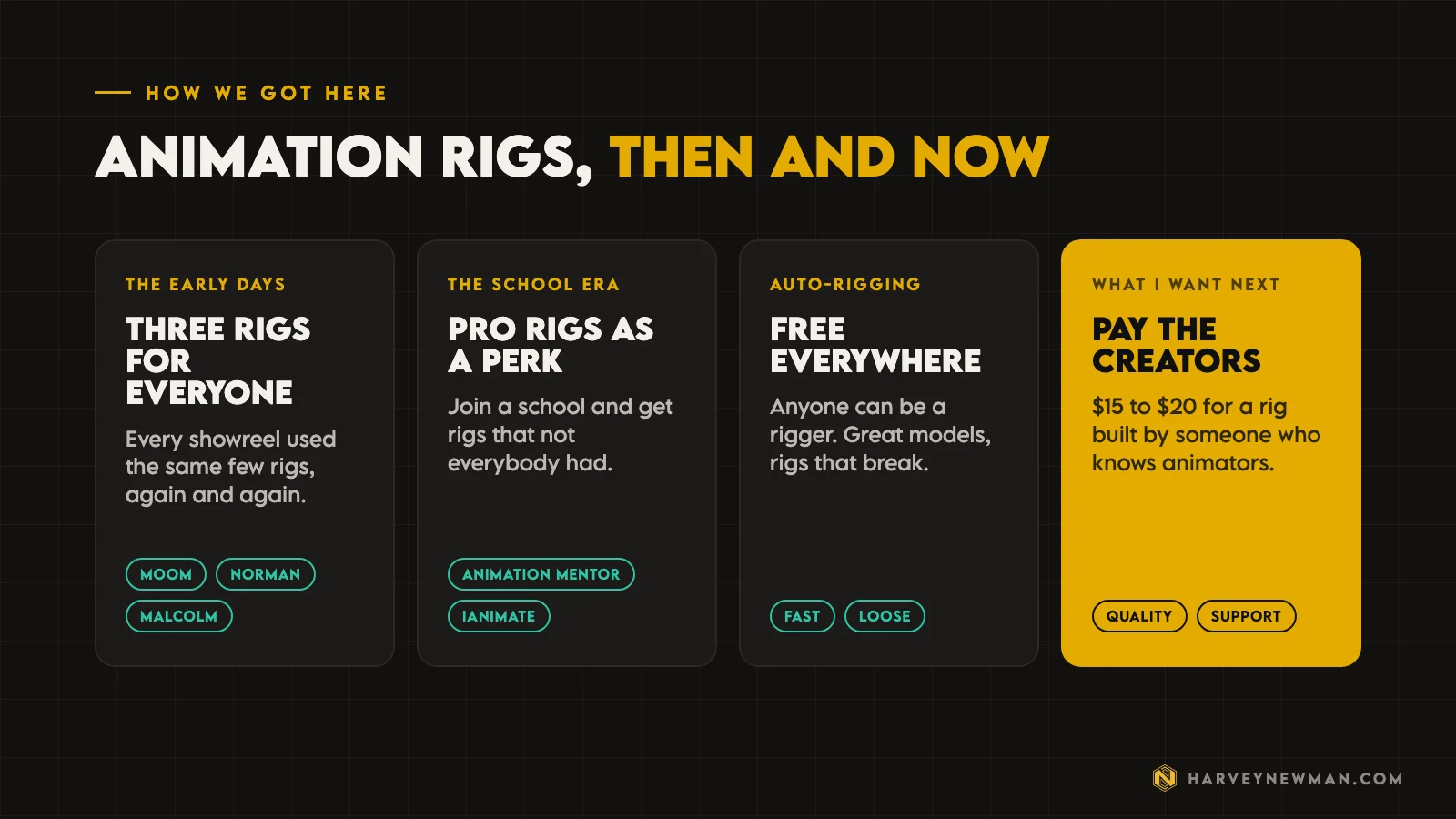
For years, almost everybody used the same three rigs on their showreels: Moom, Norman and Malcolm. You used and abused them, and so did everyone else. If you remember these, you’re my people.
How Animation Mentor changed animation rigs
Then Animation Mentor and iAnimate arrived. One of the perks of joining Animation Mentor, and I remember it well, was access to their rigs. They had a handful: a little ball with a squirrel-like tail, a biped, maybe two or three in total.
Getting those rigs felt special. Everybody else was still using the same three, and now you had something different. If you wanted a unique rig before that, you had to pay a rigger to build it. Now you had professionally made rigs that said “I know what I’m doing” on your showreel.
It taught me something: if you want your showreel to be better, you invest in yourself. When I bought those things, it was about showing people how much I wanted this. And for the people watching showreels, seeing Animation Mentor work early on was like a stamp of approval. This person is learning from the pros.
Did auto rigging kill rig quality?
Between then and now, we got plenty of auto rigging tools, tools that make everybody a rigger. Find a good model and you can have a rig in minutes.
The same thing happened with books and courses. Anyone with YouTube can make a course. With AI, a book is easy to write. It all gets fast and loose. What you lose is the quality, the know-how and the stability you get from something professionally made, whether that’s a rig, a book or a tutorial. A professional spent time thinking about it because they’ve lived the struggles you’re about to go through.
Ask any rigger. If you build a rig from the ground up at least once, without auto rigging, your knowledge goes to a whole new level. You learn:
- JointsHow to place them and how they connect.
- OrientationsHow each joint is oriented, so rotations behave.
- WeightsPainting them correctly so the mesh follows the skeleton.
- DeformationMaking sure the body deforms properly in every pose.
Believe it or not, some people call themselves riggers without ever building a rig from scratch. This isn’t to knock anybody. If you want to see what a solid rigging framework looks like, I spoke with Miquel Campos about mGear and rigging in Maya.
What happens when free rigs break?
As an animator, not a rigger, you can’t always tell good from bad. You see a character that looks appealing, it suits your style and your shot, so you download it for your showreel.
Then you go to animate it and realise the rig is rubbish.
You go to do something a bit more extreme, and it falls apart.
Harvey Newman
We’ve all been through it. You open the rig, excited because the model looks great. You don’t know why it’s falling apart, you just know it’s complicated to animate with:
- Things break all the time.
- You can’t find the controller you need.
- Some controllers are missing entirely.
- The pole vectors are gone and you don’t know where.
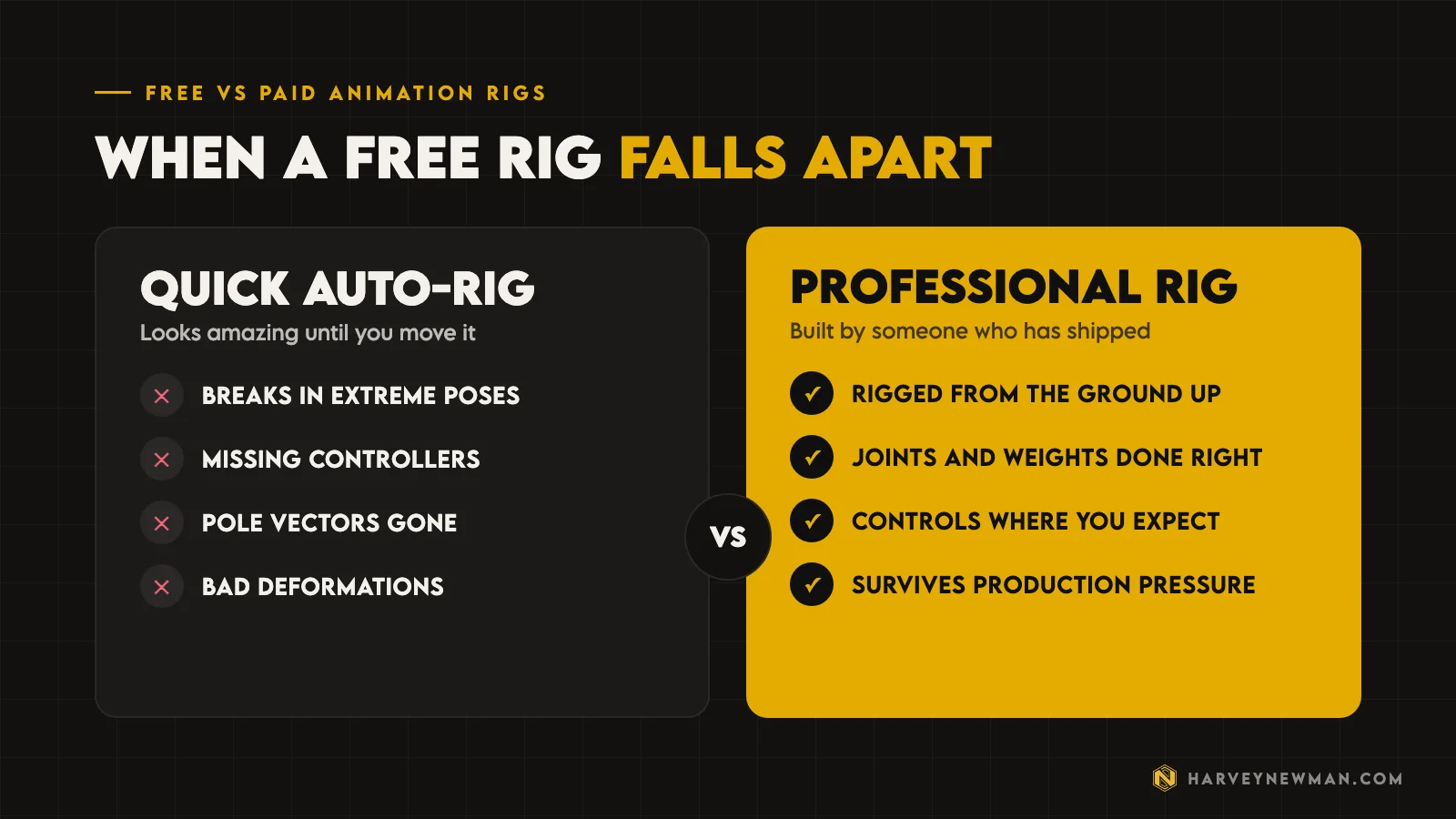
So much goes wrong because of a lack of know-how about what an animator needs. A good rigger or technical animator has been through those motions and talked with plenty of animators. They know what to do and what not to do, and when they get it right, animators are happy.
They’re also used to production: high pressure, lots of rigs, lots of animations. A production rig has to work all the time, for many reasons. If we keep waiting for free stuff, we degrade the quality of our own work, because we’re relying on whoever built that rig to have been a professional, and we often can’t tell.
Are paid animation rigs worth it?
If you want to make the best work possible, a showreel that’s absolutely baller and gets you the job, then $15 or $20 for a rig is a good deal. Especially when it’s made by someone like Emilio Serrano or Kiel Figgins, whose rigs hold up in production, or Rigging Dojo. You know you’ll get the quality you need, and your life gets easier.

I’ve talked with students and people on YouTube who tell me they never pay for rigs. They’ll wait for a free one that suits the project. When I ask why not pay $15 or $25 for the rig they want, the answer is: “Why pay for something I can get for free?”
But if you know the paid rig is the one you want, and it’s well made, why not support the creator who made it?
A great example of a paid, well made and successful rig maker is Ramon Arango. Ramon is an animator and also a rigger. If you’re in the animation community, you’ve probably seen his rigs everywhere: stylised, slightly chiselled, lots of different models. His success shows the community will pay for well made assets. It isn’t everybody yet, but I hope it’s a trend on the way up.
Why I built Animworks
This might sound like I’m telling you to buy things instead of getting them free because I run Animworks. It’s far from that.
I hope Animworks becomes the place where you can always get assets you can trust, whatever you’re buying, so you have fewer decisions to make. And I’d love it to be a place where creators get paid for their hard work, so they want to create more.
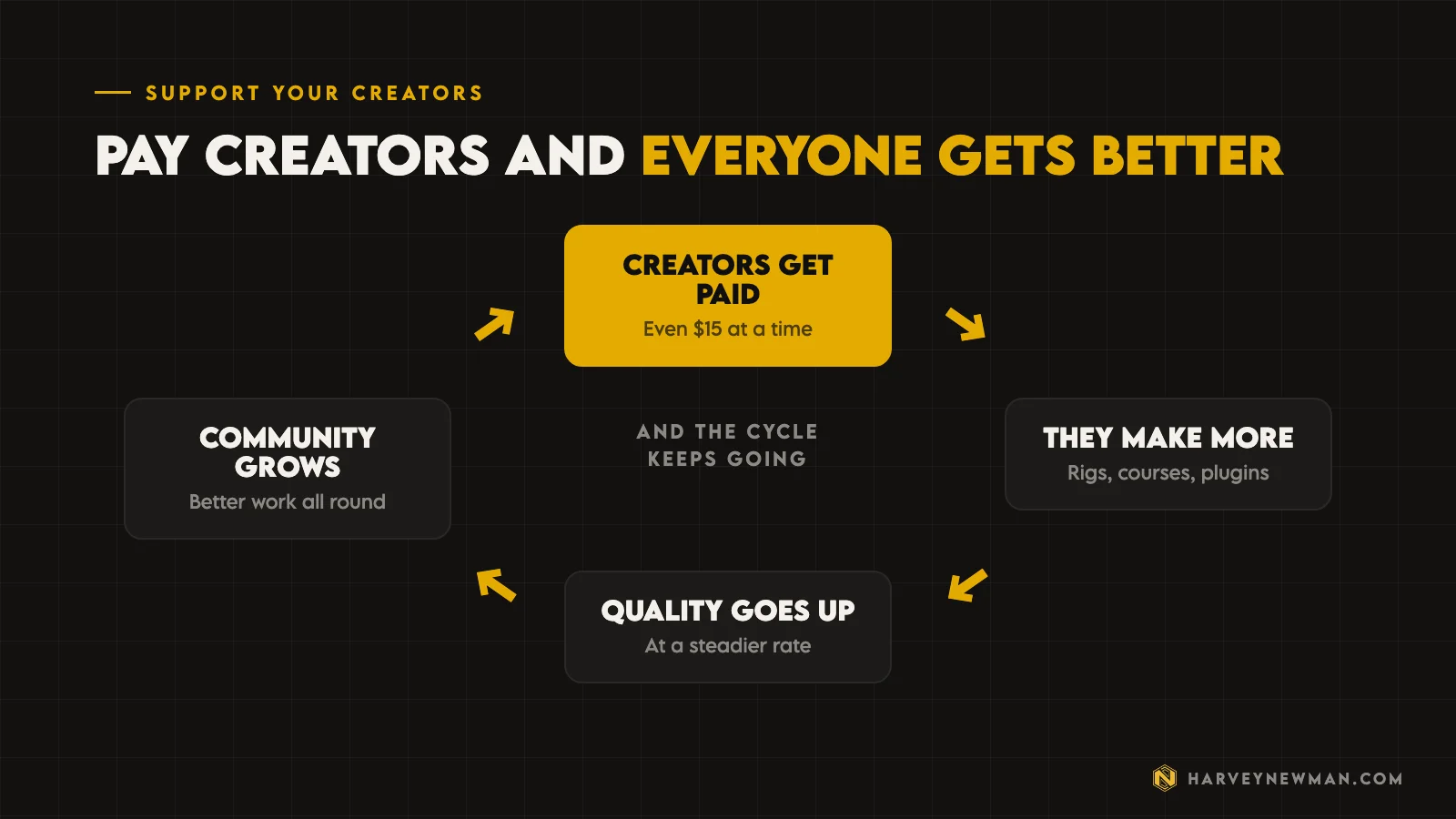
Empower the people making courses, books, rigs and plugins with a bit of money on the side. It might not be life-changing, but I think they’ll feel motivated to do more. Sell 20, 100 or 200 of something at $15 or $20, and it becomes an interesting proposition.
On top of that, the industry is in shambles right now. People can’t get jobs, and layoffs and redundancies are everywhere. I think this is a genuinely viable way for people to help each other and make a little money for themselves by helping the community. That’s what Animworks is: a place where creators and users meet in the middle. If you’re thinking of teaching what you know, I wrote about how to create an animation course.
Support the creators who support you
I believe the only way for the animation and games community to be self-sustaining is to invest in the people who are there to help us.
Shout out to every creator who has been doing this for free for years. It takes real passion to keep going that long. I know, because I’m one of them with this YouTube channel and everything I do around the community.
Support them so they can support you, and keep supporting others.
Harvey Newman
Maintaining a rig, a plugin or a piece of software is super hard. If you have it in you, support the creators doing this work. It doesn’t have to be on Animworks. Any website is fine. Just support them.
We’ve got to be better, and we’ve got to be self-sustaining as a community.
After a year talking with creators and seeing the other side of the wall, it’s sad how things are. It won’t change tomorrow, but over the next months and years I hope we start supporting the people who support us.
Do you pay for rigs, or wait for the free ones? Tell me in the comments on the video.
The video
Watch the full breakdown
Questions people ask
Are free animation rigs good enough for a showreel?
Some are. Many free rigs look appealing but break when you push them: missing controllers, lost pole vectors, bad deformation. A rig built by an experienced rigger or technical animator is far more likely to hold up.
How much does a good animation rig cost?
Many professionally made rigs cost around $15 to $25. For something that makes your showreel better and your work easier, that's a small investment.
Why are paid animation rigs better than auto rigs?
A rigger who has built rigs from the ground up understands joints, orientations, weights and deformation, and knows what animators expect in production. Auto rigging tools skip that knowledge, so problems show up when you animate.
Where can I buy professional animation rigs?
Animworks has rigs and courses from working creators. Ramon Arango, Kiel Figgins, Emilio Serrano and Rigging Dojo are good names to look up too.
What were the classic free Maya rigs?
For years, almost every student showreel used the same few rigs: Moom, Norman and Malcolm.
And remember,
there are no shortcuts for animation.
 Stay well, stay safe,Harvey NewmanBook a free call →
 Looking for knowledge?How to Thrive in the Games Industry: The Long GameMy book on building a career in games and keeping it. CRC Press, 246 pages.Get the book →
 Looking for resources?Rigs, courses and mentors on AnimworksFree and paid rigs, courses from working pros, one to one mentoring and mocap packs.Visit anim.works →
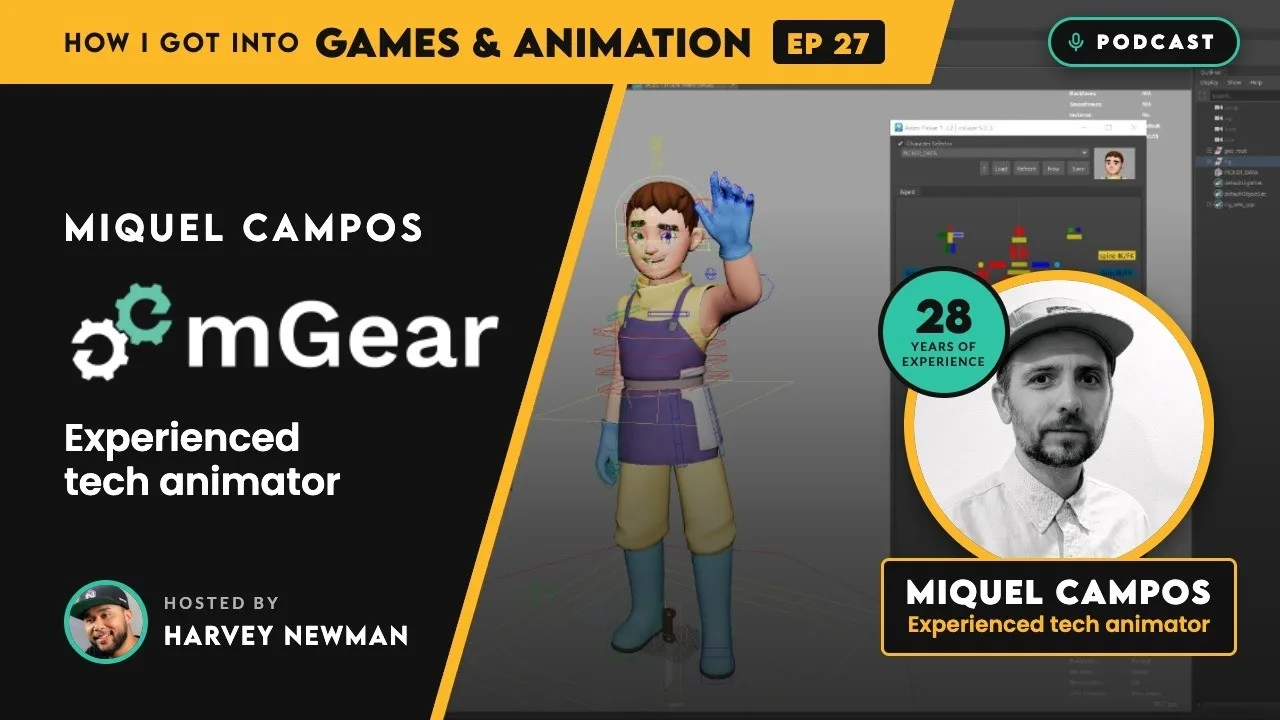 mGear: Why the Maya Rigging Tool Studios Rely On Is Still Free30 Oct 2026
 How to Create an Online Course for Animation: What I Wish I Knew First24 Jul 2026
 Can't Find Animation Jobs? Advice for Animators Struggling Right Now23 Jan 2026
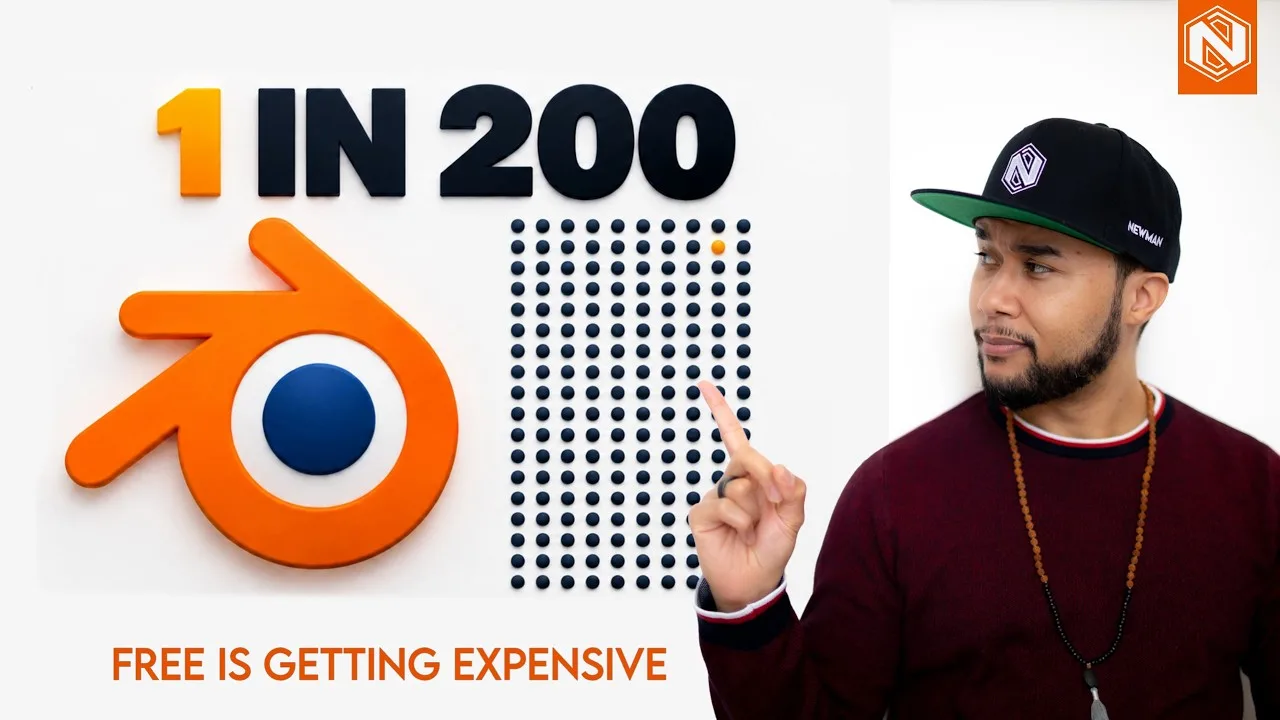 Blender Funding: Only 1 in 200 Users Pays Anything11 Sept 2026