
Industry7 min read14 min video
Toy Story 5 heads for a billion. Pixar lays people off anyway.
Pixar Layoffs, Tippett Closed: What's Really Killing Animation Studios?
Key takeaways
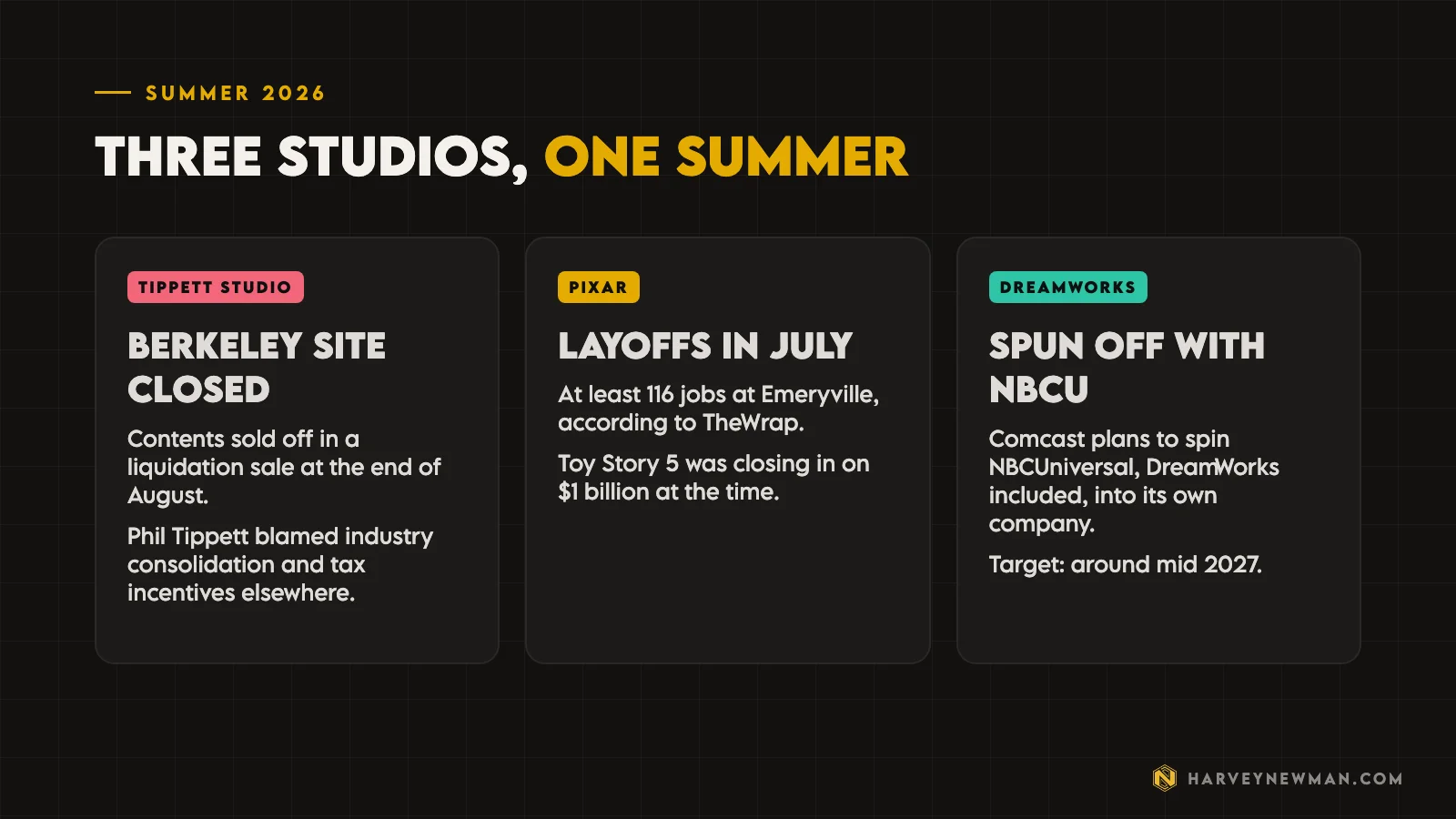
- In one summer Tippett Studio left its Berkeley home after bankruptcy, Pixar cut jobs while Toy Story 5 closed in on $1 billion, and DreamWorks became part of Comcast's NBCUniversal spin-off.
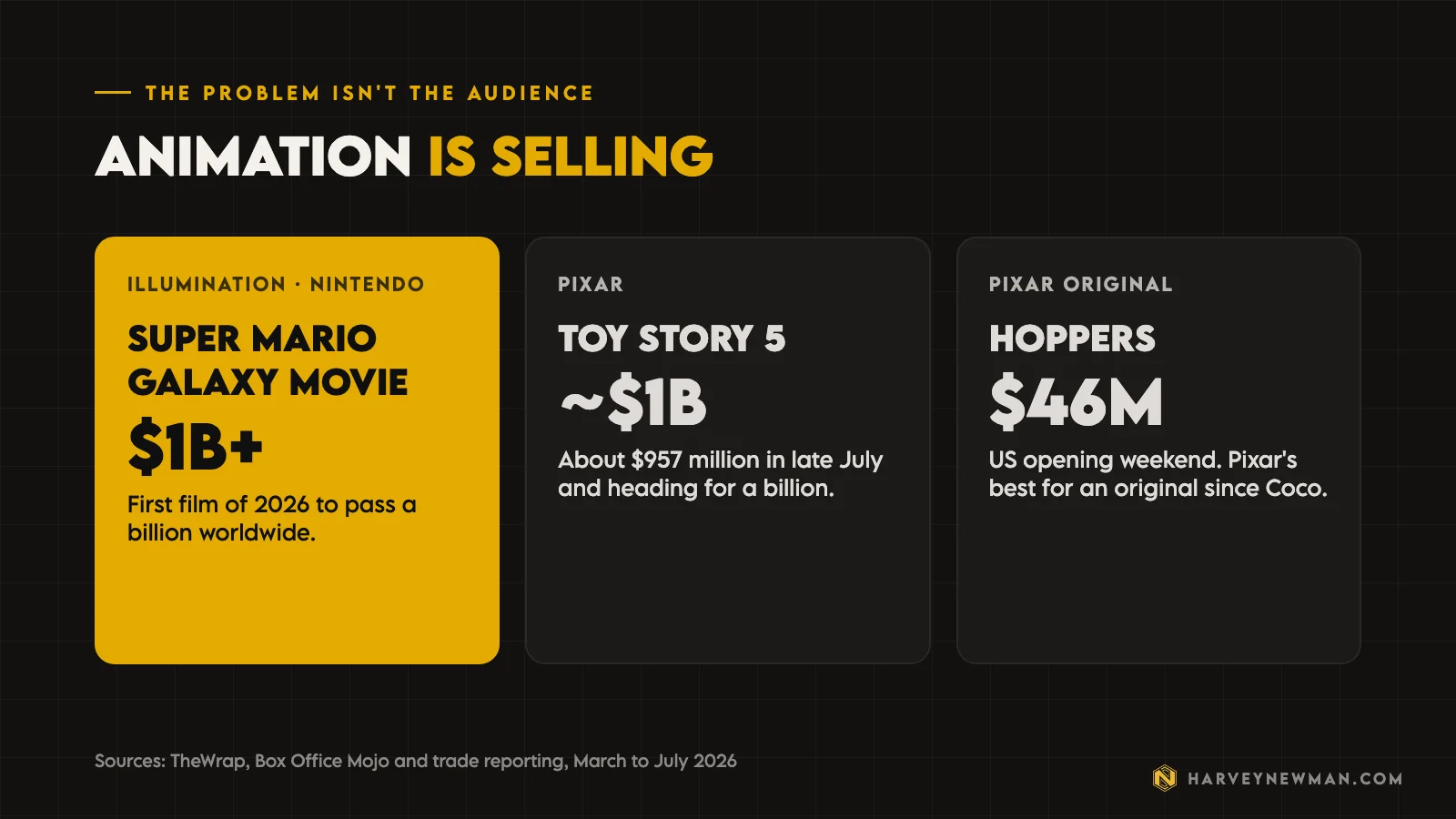
- Animation is selling. The Super Mario Galaxy Movie passed $1 billion and Hoppers had Pixar's best opening for an original since Coco.
- AI is squeezing some work, like roto, clean-up and look dev. It isn't why these studios are in trouble.
- Three things compound: consolidation, franchise-only greenlighting, and an audience that moved to YouTube, TikTok and Roblox while the financing model stayed put.
- Smaller teams, niching down and strong communities are where I think the next great animated films come from.
I recorded this at the start of September 2026. In a few weeks, Tippett Studio left the Berkeley home it had worked from for decades. Pixar laid off staff while Toy Story 5 was closing in on a billion dollars. And DreamWorks was thrown into a corporate spin-off that looks long and complex.
Everybody is saying the same thing about the Pixar layoffs and the studio closures: it’s AI. Because that’s the easy answer.
I don’t think AI has much to do with it. Here’s what I think is going on, and why it might be coming for the games industry next.
This one is about film animation, which is a bit different for me. But film is going through it in a massive way, bigger than games, and much of this news is getting swept under the rug.
What happened to Tippett Studio?
Phil Tippett. If you’re an animator and you don’t know the name, you should. The man is a legend.
- The creatures and walkers in Star Wars, the AT-ATs and the Rancor: that was Phil Tippett.
- The dinosaurs in Jurassic Park: Phil Tippett.
- RoboCop’s ED-209: Phil Tippett.
His studio worked on so many productions over the years. What happened was sad. In March 2024 Indian VFX company PhantomFX agreed to buy a majority stake, and that May the studio filed for Chapter 11 bankruptcy. This summer it left its long-time Berkeley facility, and at the end of August there was a liquidation sale of decades of props, models and equipment. I wish I could have been there to buy some of it.
The studio says it isn’t shutting down completely and will keep working in a new form. But the building is gone, and I feel like people aren’t talking about it or celebrating the work of this man.
As for why, Phil Tippett himself pointed to consolidation in the business, along with tax incentives elsewhere. Keep that word in mind. It comes up a lot.
The Pixar layoffs paradox
Pixar has meant so much to all of us and has done so much for the animation industry. Toy Story 5 is a success. It was past $957 million worldwide in late July and heading for a billion. People can’t get enough of that IP.
So instead of investing in their people for the next Pixar film, they laid people off. TheWrap reported at least 116 jobs at Pixar’s Emeryville headquarters, as part of several hundred Disney cuts in July. Pixar said it was refocusing on theatrical features.
These were people who had been at Pixar for years, with the talent and knowledge that come from building films at the highest level.
Disney made a billion dollars out of a movie, and they can’t pay people at Pixar to keep working. Something is missing.
From Blue Sky to DreamWorks: a pattern of consolidation
This isn’t new. Blue Sky closed in 2021, and about 450 people lost their jobs. Man, I miss Blue Sky. Disney had inherited it when it bought Fox, and the message was that one company didn’t need a third animation studio.
I remember talking with my peers at the time and wondering what that meant for the industry. It was a warning sign.
Disney bought Pixar back in 2006, and from the outside it felt like Pixar was doing better than Disney Animation at the time. My opinion, and it is only my opinion, is that some of the same consolidation is happening behind the scenes now, with Disney slowly absorbing the business.
Then there’s DreamWorks. Comcast plans to spin NBCUniversal, which owns DreamWorks Animation, into its own public company, with a target of around mid 2027. If we’re not careful, DreamWorks could end up where Blue Sky did: hollowed out and swallowed by deals. It’s a studio that has already shrunk, now sitting on top of a restructure. That isn’t stable for the industry, and it isn’t stable for the animators working there.
Animation is selling. So why are animation studios closing?
If you’ve read this far you might be thinking the industry is collapsing. Movies aren’t selling, there’s no future, why would anyone want to be an animator.
That’s how it looks from the outside. I disagree.
Animation is obviously selling, and there is a market for it.
- The Super Mario Galaxy Movie became the first film of 2026 to pass a billion dollars worldwide.
- Hoppers opened to $46 million in the US, Pixar’s best opening for an original film since Coco.
- Toy Story 5 is heading for a billion as well.
To be fair, a source told TheWrap the Pixar cuts were partly blamed on Hoppers being seen as underperforming over its full run. But the big picture holds.
The problem is that sequels and big IP get a massive marketing push from the big corporations, and new ideas get muted. I think that’s the crux of it. AI didn’t cause that, and AI can’t fix it.
Why animators feel disposable
There’s another problem compounding all of this. Variety ran a piece this year that nailed it: animation is propping up Hollywood’s bottom line, and animators have never felt more disposable. One animator described reading article after article about how much money these films make, then watching the people who made them get low pay, redundancies and dismissals.
Pete Docter, Pixar’s chief creative officer and a brilliant director, told Variety that the world still sees animation as “films for kids”, because most animated films are “funny, goofy, [and] a little bit like babysitter material.”
I think he’s right, and it has always been this way. I’m not saying animators did this to themselves. The marketing, and the companies asking for this kind of film, are doing it to animation. It’s up to us to change it.
The numbers behind the animation layoffs
This is where it gets heartbreaking. It’s bigger than one studio.
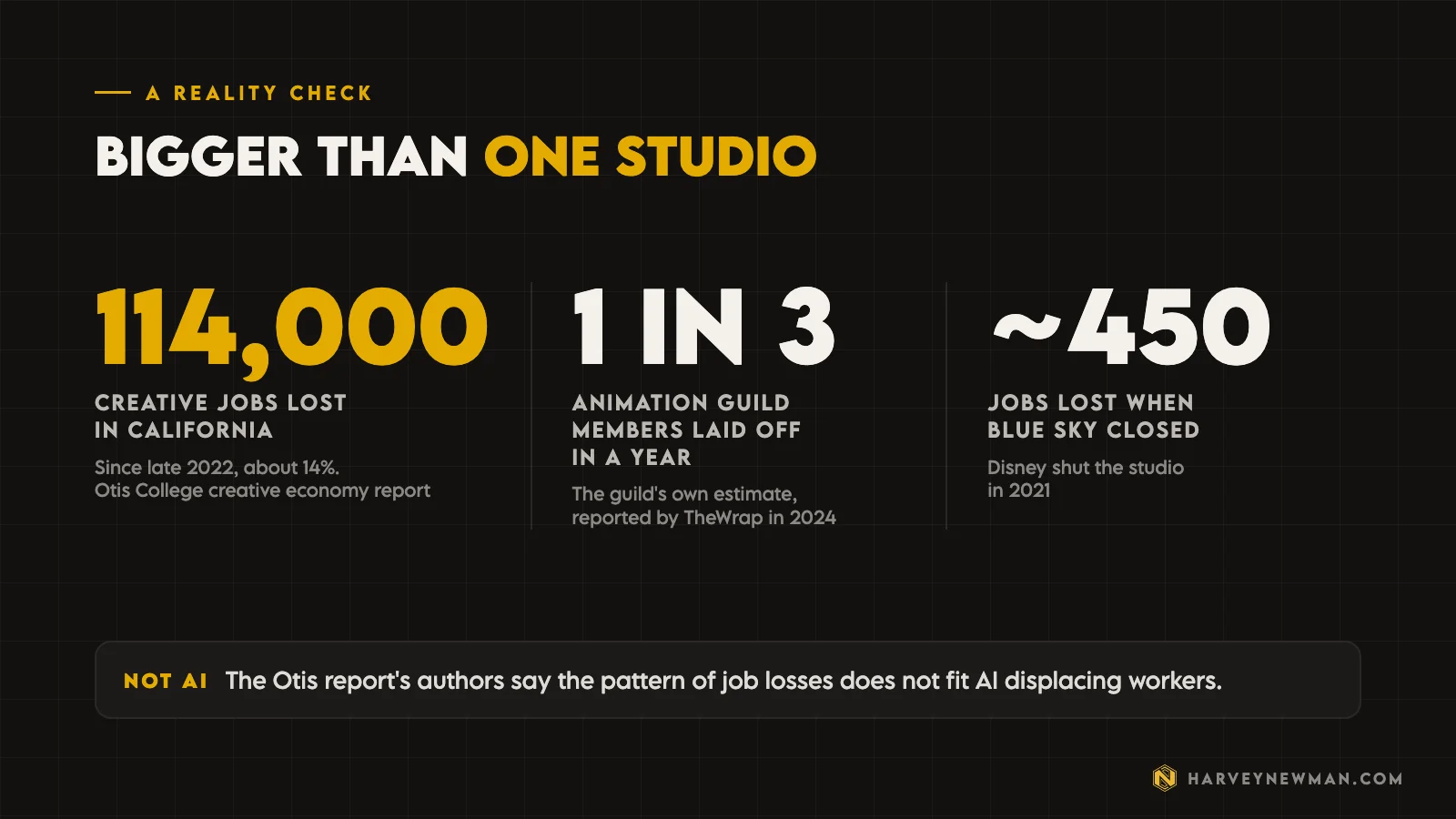
- California has lost roughly 114,000 creative economy jobs since late 2022, about 14%, according to Otis College of Art and Design.
- In 2024 the Animation Guild estimated that at least a third of its members had been laid off in the previous year. A third. And the guild is massive.
Interestingly, the Otis researchers also say the pattern of losses doesn’t fit AI replacing workers. I wrote more about what this means for individual careers in the reality of being an animator.
If you lost a job in film or animation this year, I’d love to hear from you.
What’s really killing animation studios?
Is it AI? Partly. AI is squeezing some jobs out: rotoscoping, clean-up, look dev, some VFX. It saves on budgets and gets films made faster with fewer people, and that’s a real problem for those roles.
But it isn’t replacing storytelling, and it isn’t why Tippett closed its doors in Berkeley.
- ConsolidationFewer companies own everything. Every merger comes with layoffs, and fewer studios means less creativity.
- Franchise onlyStudios are scared of losing money, so they bet on the sure horse: two, three, four, five.
- The audience movedKids watch YouTube and TikTok and play Roblox. The financing model hasn't caught up.
The franchise problem worries me. The further down that road we go, the fewer originals we get, until it’s an echo chamber of more of the same.
The third one is the one I think will bite hardest. Kids aren’t watching cartoons and morning TV like we did. The audience moved. The money didn’t.
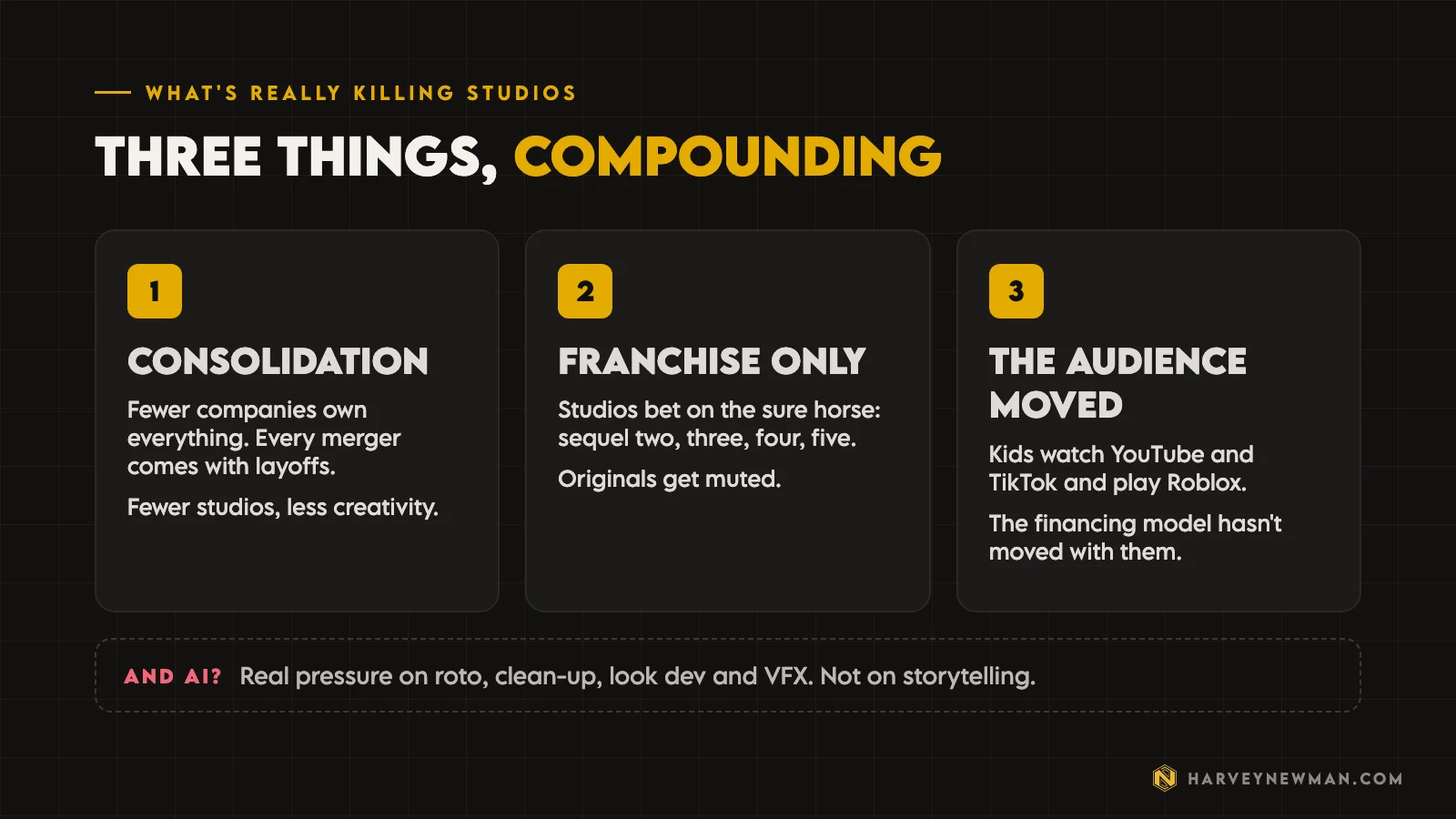
AI is not so much to blame. It's a compounding effect of all three.
Harvey Newman
Where the work goes next
As usual on this channel, I want to end on the positives.
As the big studios merge and get bigger, I think the same thing that’s happening in games will happen in film. Smaller teams will make better, more creative films, faster. You can already see it in live action. Alongside the big studio releases this year we had Backrooms, made for around $10 million and now A24’s biggest film ever, and Obsession, an original thriller that crossed $100 million in the US. Those are more creative than most of what Hollywood has put out in years, and that gets me excited about animation.
If you want to be part of that, I think niching down is the way, just like in games. Find your people. Don’t wait for anybody. Do it because of passion. Pixar and Disney both started that way. If you believe in your story, your characters and how you’ll put it together, you’ll find people who believe in your vision too.
And communities are going to be the bread and butter of the future. I see it with this channel and with what we’re building at Animworks. The animation community is strong, and we like to help each other.
Check me in five years. I think we're going to have a future full of creative movies.
Harvey Newman
It might be creative shorts first, but it will be films eventually. If you work in games, pay attention, because this is coming for us too. I made the same argument about the games side in why the Xbox studios might be better off now.
Were you affected by the Pixar layoffs or any of the other cuts this year? Tell me in the comments on the video.
The video
Watch the full breakdown
Questions people ask
Why did Pixar lay off staff in 2026?
Disney cut several hundred jobs in July 2026, and TheWrap reported at least 116 of them were at Pixar. Pixar said it was refocusing on theatrical features. A source told TheWrap the cuts were partly blamed on the perceived underperformance of Hoppers, even though Toy Story 5 was heading for $1 billion.
Did Tippett Studio close?
Tippett Studio left its long-time Berkeley facility in 2026 after Chapter 11 proceedings, and sold off its contents in a liquidation sale at the end of August. The company said it would keep working in visual effects and animation. Phil Tippett blamed industry consolidation and tax incentives elsewhere.
Is AI killing animation studios?
Partly, at the edges. AI is squeezing roles like rotoscoping, clean-up, look dev and some VFX. But it isn't replacing storytelling, and it isn't why Tippett or Pixar are where they are. Consolidation, franchise-only greenlighting and a shifting audience matter far more.
What is happening to DreamWorks Animation?
Comcast plans to spin NBCUniversal off into its own public company, targeted for around mid 2027, and DreamWorks Animation goes with it. More restructuring on top of earlier cuts makes it an unstable time for the animators working there.
Is the animation industry dying?
No. Animated films are some of the biggest earners in Hollywood right now. The audience is there. The problem is how studios are owned, what they choose to greenlight and how slowly the business has adapted to where kids now watch.
And remember,
there are no shortcuts for animation.
 Stay well, stay safe,Harvey NewmanBook a free call →
 Looking for knowledge?How to Thrive in the Games Industry: The Long GameMy book on building a career in games and keeping it. CRC Press, 246 pages.Get the book →
 Looking for resources?Rigs, courses and mentors on AnimworksFree and paid rigs, courses from working pros, one to one mentoring and mocap packs.Visit anim.works →
 The Reality of Being an Animator in 2026: How an Animation Career Has Changed16 Oct 2026
 Xbox Layoffs Cut 4 Studios. Why They Might Be Better Off Now31 Jul 2026
 Will AI Replace Animators? No, But Ignoring It Will Cost You30 Jan 2026
 The Art of Animation: Bringing Stories to Life30 Oct 2024