
Tools9 min read21 min video
UE5 + UEFN = UE6. Blueprints aren't in the long-term plan.
Is Epic Killing Unreal Blueprints? What Epic Said About Verse and UE6
Key takeaways
- Unreal Engine 6 merges UE5 and UEFN into one engine. Epic is targeting Early Access at the end of 2027, with full release 12 to 18 months later.
- Scene Graph, built on the Verse language, is the new gameplay framework. Entities and components take the place of Actors.
- Epic said Blueprints and Actors stay in early versions of UE6 and will be deprecated when the new framework is mature. They gave no date.
- Text based scripting is easier to maintain and merge than Blueprints, and it fits a world of AI tools. That is my read on why Epic is doing this.
- Blueprints opened game making to artists and animators. Whatever replaces them needs to keep that door open.
Like many of you, I sat down to watch State of Unreal 2026. Halfway through I had to put my drink down. What Epic was telling us is that the way we’ve built games in Unreal for the past ten to fifteen years is slowly fading away, and unreal blueprints are part of that.
The headlines say Epic is killing Blueprints. That’s close, but it isn’t what Epic said, so in this post I’ll stick to what Epic has announced, then give you my take as an artist and animation director.
The way we’ve been building games is slowly fading away.
We’ll cover three things: what else shipped in Unreal Engine 5.8, what Unreal Engine 6 means for Blueprints, Verse and Scene Graph, and the bigger question of vibe coding and AI in game development.
What shipped in Unreal Engine 5.8 besides animation?
I already made a video and post on the animation side of Unreal Engine 5.8. There was a lot more in this release than I expected, so here’s the quick version.
- Mesh Terrain. A new, experimental way to build terrain that should make world building a lot easier.
- MetaHuman Collections. Many MetaHumans together, almost like crowds, with different animations and facial expressions. MetaHumans have always been heavy, and this tells me Epic has been working on that behind the scenes.
- Lumen Lite. A lighter global illumination mode. If you have a top machine with loads of RAM and a great graphics card, Lumen runs fine. On a lower spec machine it bogs down the memory, and I’ve seen that first hand. With the price of RAM and graphics cards right now, I’m glad Epic did this.
- Tools graduating to production. MegaLights, Dataflow and the Chaos Cloth tools, Live Link Hub and the Movie Render Graph are now production ready.
I love that last one. Epic releases a tool in beta, the internal team and the community help build it out, and then it graduates. That’s the way to build tools. Production ready means hardened, which should mean fewer crashes and fewer problems.
Is Lore the answer to Perforce?
Last but not least: Lore. Lore is Epic’s version control system, and Epic has now released it as open source.
Perforce is the version control software I’ve used for my entire career. Everybody puts their data, assets and graphics on a server. You check files out and check them in, so nobody overwrites anyone else, and you keep the history, so you can go back to the version from two months ago. Perforce is sturdy and it works, but it’s old and it hasn’t changed much in a long time.
If you’ve hosted Perforce for a team, you know how expensive it gets. An open source alternative from Epic could save studios real money on hosting. It’s early days for Lore, so I’d test it before moving a production over.
What is Unreal Engine 6?
This one comes straight from Tim Sweeney: UE5 plus UEFN equals UE6. Epic is merging Unreal Engine and Unreal Editor for Fortnite into one engine.
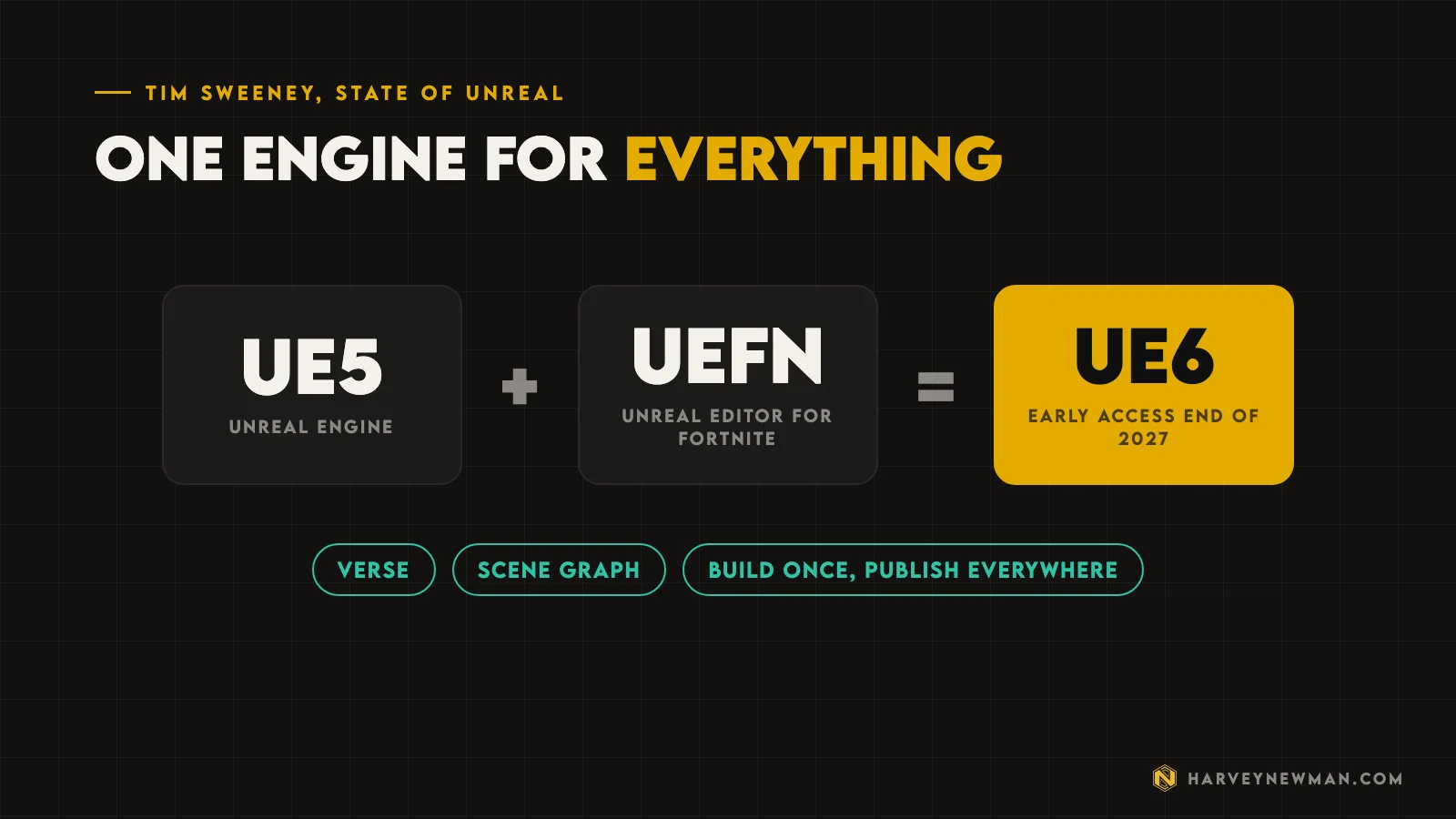
What I hear Epic saying is: build your game once and publish it everywhere, PC, mobile, whatever it is, with Unreal as the driver.
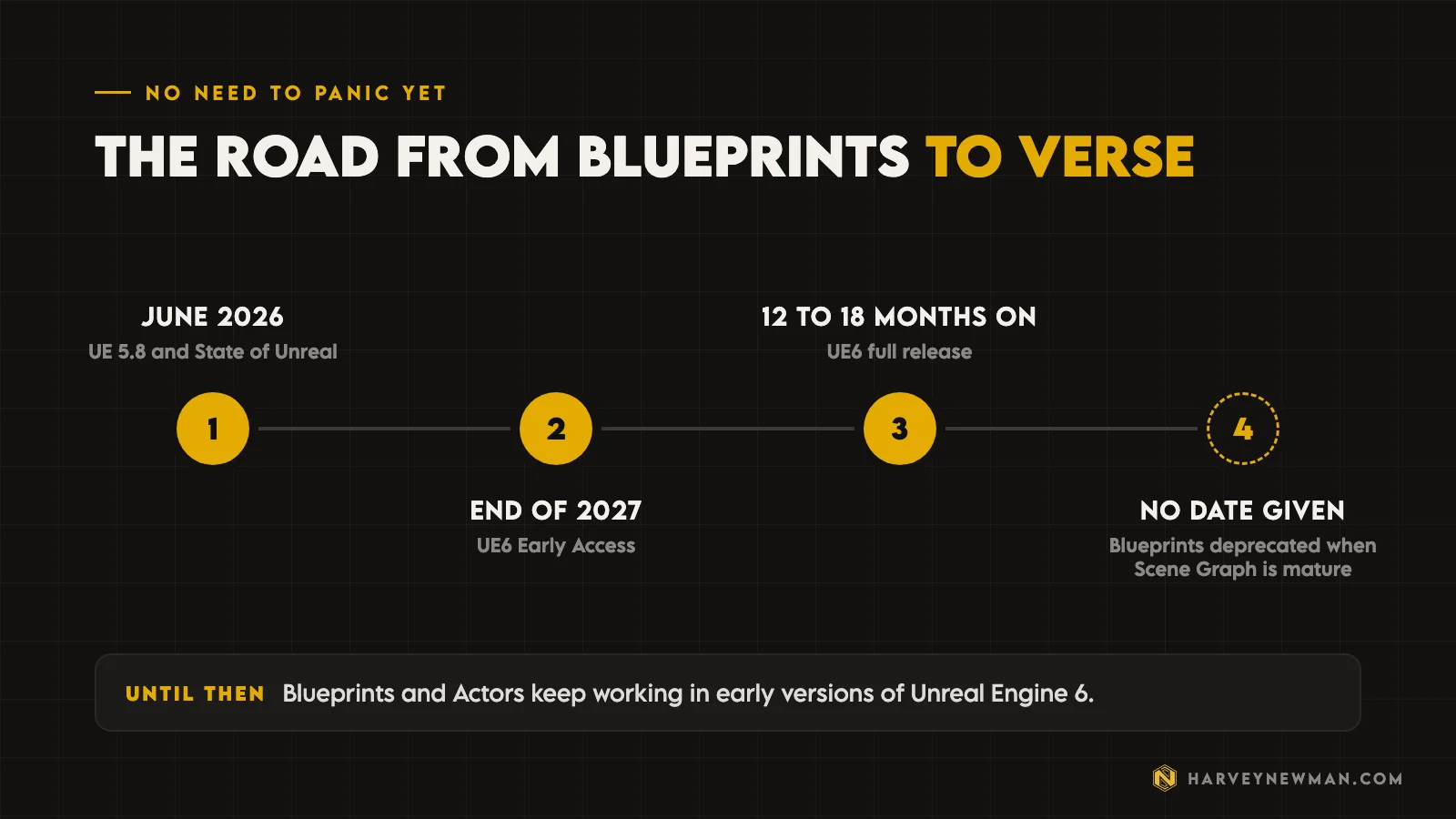
Before anyone panics, Epic is targeting Unreal Engine 6 Early Access at the end of 2027, with the full release 12 to 18 months after that. We have time. And Epic develops in the open: they put alpha and beta versions in our hands, we give feedback, and they fix things. I think that’s brilliant.
From the way Tim Sweeney spoke, I don’t think Unreal 6 is a brand new engine. It felt more like he was telling us where game development is going from here.
Are Unreal Blueprints being deprecated?
UE6 comes with a new foundation called Scene Graph, and Scene Graph is built on Epic’s own language, Verse. Verse is text based, and Epic says it should feel familiar to anyone who has worked with Python or C#.
Building a programming language is a huge task, and it most likely took them many years. The last company I remember doing this was Apple with Swift for iPhone apps. Epic wants to do the same with Verse.
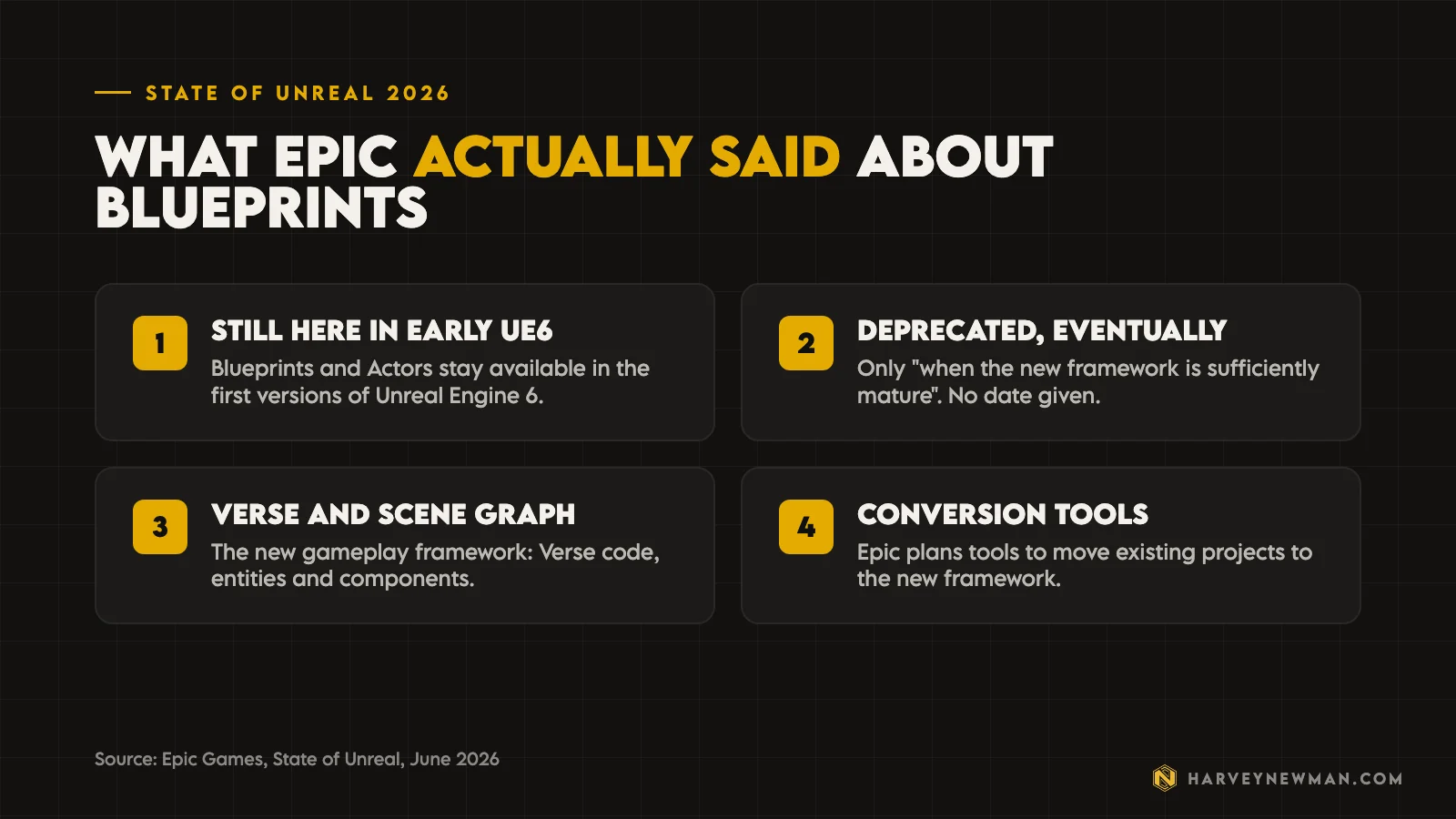
Here’s exactly what Epic said about Blueprints at State of Unreal:
- Still supportedBlueprints and Actors stay available in early versions of Unreal Engine 6.
- Deprecated laterEpic says they will be deprecated "when the new framework is sufficiently mature". No date was given.
- Scene Graph replaces ActorsEntities made of components, with prefab style workflows, all driven by Verse.
- Conversion toolsEpic plans tools to move existing projects over to the new framework.
So Blueprints aren’t being switched off in UE6. But they aren’t part of the long-term plan either, and that’s what has split the community.
An update since the video: at Unreal Fest Tokyo in November 2026, Inven Global reported, citing Japanese outlet Game Makers, that Epic’s keynote slides marked Blueprints, Actors and the C++ gameplay framework as “Remove”, and that Tim Sweeney called it a painful change. The same report says Epic plans AI assisted tools to convert Blueprint and C++ gameplay code to Verse. Check Epic’s own UE6 roadmap for the latest before you plan a project around it.
Why do Unreal Blueprints matter so much?
Blueprints are Unreal’s visual scripting system, and they arrived when Epic and Crytek were fighting over who had the best engine.
Before visual scripting, engineers hard coded everything in the game. Artists made the assets and handed them over, and the engineers made them work, somehow, through magic.
Visual scripting gave artists a window in. People who connect nodes better than they write code could see where things started, what happened in the middle and how they ended. For animation it mattered even more. You can see your movement sets: an idle state, a run state, and the transitions between them. All visual, and easy to follow. When most of us saw it, we agreed this was the way to go.
There’s always been a debate behind the scenes that Blueprints aren’t optimised enough to ship a game without an engineer cleaning up after you. Then came Clair Obscur: Expedition 33. A small team built a massive hit, Game of the Year, leaning heavily on Blueprints.
Did you get into Unreal because of Blueprints?
Harvey Newman
I know many people whose only reason for making games in Unreal was visual scripting. If that’s you, this change hits hardest.
Why is Epic replacing Blueprints with Verse?
If people love Blueprints this much, and a small team can ship a Game of the Year with them, why phase them out now? This is my opinion, not Epic’s.
Text based scripting is easier to maintain, to merge and to get people working together. Put two people on the same Blueprint and it becomes a fight. You work on it alone, check it in, the next person checks it out, and so on.
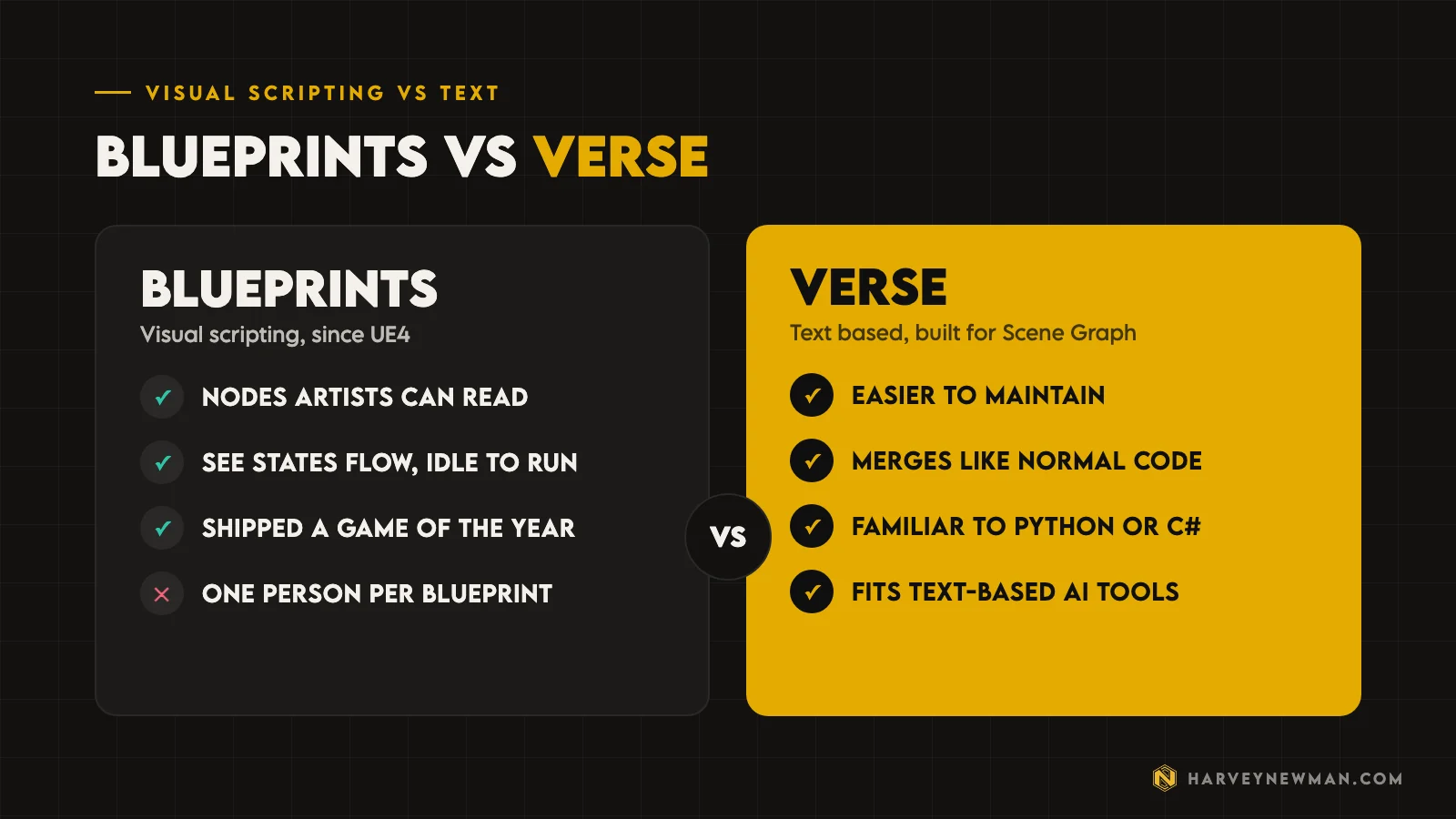
I think the world Epic built around Blueprints doesn’t gel well with the world we’re heading into, which is text based scripting. And that leads straight to the third controversy.
What is vibe coding in Unreal Engine?
In 5.8, Epic released an MCP plugin. It lets an AI model like Claude or Gemini control Unreal with plain language. You ask the engine to do something, it does it, and you tweak it here and there. That’s vibe coding.
As a plugin, I’m all for it. A plugin is optional. If you want it, download it. If you want to keep working the way we always have, ignore it and carry on with Blueprints.
But if we head towards a world where you have to vibe code your gameplay, my question is: is that still game development? It forces you to learn skills that aren’t game development skills, like how to prompt the engine for what you need. It starts to look like Claude or ChatGPT, with a pile of YouTube videos telling you what to ask and how to ask it.
How do you get the artistry of making games together with vibe coding a game?
Will AI make every Unreal game look the same?
I don’t think it’s true today, but plenty of people already say Unreal games are starting to look the same, because most developers have the same tools. Back when most studios had their own engine, they came up with different solutions to the same problems.
Now imagine we vibe code a level, a lighting setup, a mechanic or a movement. Are we borrowing from games that came before us? Maybe code from a game that came out ten years ago ends up in yours without you knowing. It looks good, it feels good, and when you publish it, it turns out to be another Max Payne.
AI can only learn from what has been done before. Games have always been about thinking outside the box. That’s why indie and AA games are thriving right now: they keep coming up with fresh ideas, made by people who sat down together where there was nothing before.
Tim Sweeney has also said that a “made with AI” label makes no sense for games, because AI will touch nearly every part of production. If the line between AI made and human made dissolves, does that make games less human?
What makes a piece of art artistic is the struggle, and the learning.
Harvey Newman
Think about Clair Obscur. A small team in France, many of them working together for the first time, climbing their own Everest. Or the stories behind Half-Life, or Titanfall and the studio put together to make it. Those human stories are what connect us to a game, and they add another layer of appreciation every time you play it.
Is there a bright side to AI in game development?
I don’t think it’s all doom and gloom. I use Claude myself and I vibe code things in my spare time, because I need to keep up.
On the positive side, AI should help us do more with less. Teams can be smaller and more efficient, and make games that look much bigger than the team. Games now take seven to ten years to make. I’d love to get some of that time back and return to two to three year cycles: develop, ship, move on to the next one. I just hope it doesn’t cost us the creativity.
My last question is how much gamers and developers dislike AI, while Epic leans further into it. Will people move to Godot to make games the current way? Will purist engines appear that keep visual scripting and plain coding?
Final thoughts: are Unreal Blueprints dead?
Not yet, and not for a while. Epic listens to feedback, and the studio is full of talented people. If the community wants to keep Blueprints, I can’t see Epic saying “we don’t care”. The best outcome would be options: Verse for text scripting, AI tools for those who want them, and something visual for the people Blueprints brought into game development.
If you’re like me, you’re still in the middle, watching to see how this plays out. Whatever happens to the tools, the game animation pipeline still needs artists and animators who understand how gameplay and animation connect, and that’s what Blueprints gave so many of us.
Are you excited for Verse and UE6, or holding on to Blueprints? Come and tell me which side of the fence you’re on in the comments on the video.
The video
Watch the full breakdown
- 0:00State of Unreal shocker
- 0:44Unreal Engine 5.8 deep dive
- 1:29Mesh Terrain and MetaHumans
- 3:12Lore: the Perforce killer?
- 4:51Unreal Engine 6 revealed
- 5:48The death of Blueprints
- 6:58The future of Scene Graph
- 8:21Why visual scripting matters
- 10:05Verse and the shift to text
- 12:10What is vibe coding?
- 15:04AI vs human creativity
- 18:22The bright side of AI dev
- 19:45Final thoughts
Questions people ask
Is Epic getting rid of Blueprints?
Eventually. At State of Unreal 2026, Epic said Blueprints and Actors will be available in early versions of Unreal Engine 6 and deprecated when the new Verse based framework is sufficiently mature. No date was given, and Epic plans conversion tools for existing projects.
What is Verse in Unreal?
Verse is Epic's own text based programming language, first used in Unreal Editor for Fortnite. Epic says it should feel familiar to anyone who has worked with Python or C#. In Unreal Engine 6 it powers the new Scene Graph framework.
What is Scene Graph in Unreal Engine?
Scene Graph is the new gameplay framework for Unreal Engine 6, built on Verse. It uses entities made of components in place of Actors, with prefab style workflows.
When is Unreal Engine 6 coming out?
Epic is targeting an Early Access release at the end of 2027, with a full release 12 to 18 months after that. Unreal Engine 5.8 is described as the last planned major UE5 release.
What is vibe coding in Unreal Engine?
Vibe coding means asking an AI model, in plain language, to build things in the engine for you, then tweaking the result. Unreal Engine 5.8 added an optional MCP plugin that lets models like Claude or Gemini control Unreal this way.
And remember,
there are no shortcuts for animation.
 Stay well, stay safe,Harvey NewmanBook a free call →
 Looking for knowledge?How to Thrive in the Games Industry: The Long GameMy book on building a career in games and keeping it. CRC Press, 246 pages.Get the book →
 Looking for resources?Rigs, courses and mentors on AnimworksFree and paid rigs, courses from working pros, one to one mentoring and mocap packs.Visit anim.works →
 Unreal Engine 5.8: Is Epic Finally Taking Animators Seriously?5 Jun 2026
 The Game Animation Pipeline: How I Build One, AAA or Indie12 Jun 2026
 AI Animation vs Traditional Animation: What Are We Losing?13 Nov 2026
 Game Developer Skills the Industry Wants Now: How to Future-Proof Your Career13 Feb 2026