
Industry7 min read17 min video
90% is on the companies. 10% is on us.
The Games Industry Is Broken: 90% Is Them, 10% Is Us
Key takeaways
- Summer 2026 brought cuts at Bungie, Sony's move to digital-only new releases from January 2028, and about 3,200 Xbox job cuts with four studios leaving Xbox.
- Harvey puts 90% of the blame on the companies. The other 10% is ours: the choice to stay, the choice to look around and the choice to value ourselves.
- The old career ladder ends with settling at a big, prestigious studio. The bigger the company and the salary, the easier you are to cut.
- Harvey didn't leave AAA because he predicted the crash. He left out of frustration and a need for independence, and it took two to three years to match his old salary.
- Experienced developers are valuable for what they know: how pipelines and tech worked, and how to get things right the first time.
The games industry is broken. And for about six months before I shot this video, on 8 July 2026, I’d been feeling like it was healing itself.
PlayStation had shown off a run of big single-player games, Wolverine among them. We were moving back towards single-player games instead of multiplayer everywhere. It felt like we were getting to a better place.
Then the news landed.
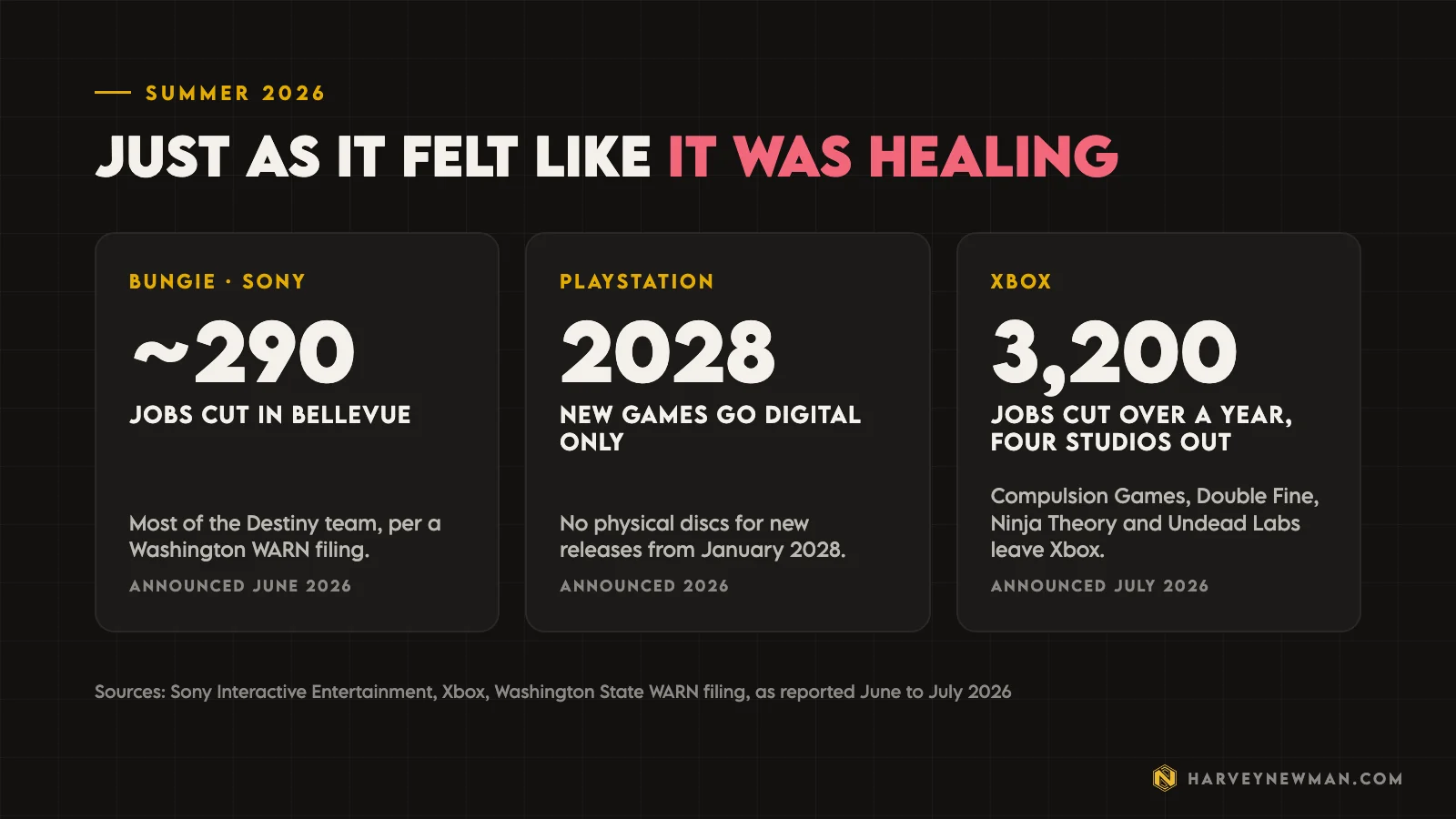
- Bungie. Sony announced major layoffs at Bungie, including most of the Destiny team. A Washington State WARN filing put the Bellevue cuts at about 290 jobs.
- Physical discs. Sony said new PlayStation games will be digital only from January 2028. That’s heartbreaking for everyone who collects.
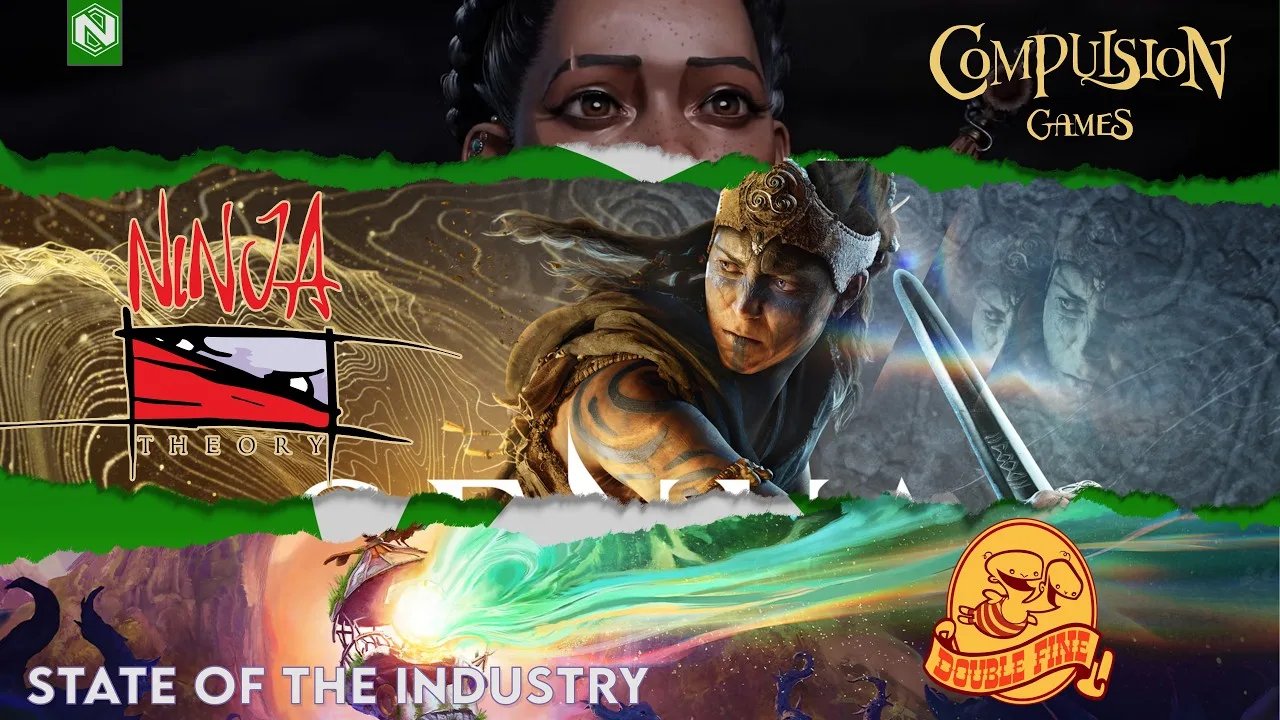
- Xbox. Xbox announced around 3,200 job cuts over the next year, and four studios leaving Xbox: Compulsion Games, Double Fine, Ninja Theory and Undead Labs.
This one is heavy, and I feel for everyone affected. But I want to say something that might sound harsh, so hear me out.
Why is the games industry broken? The 90/10 split
I think 90% of the blame lies with these companies. The other 10% is on the individual, on us, because we chose to stay in these companies for however long.
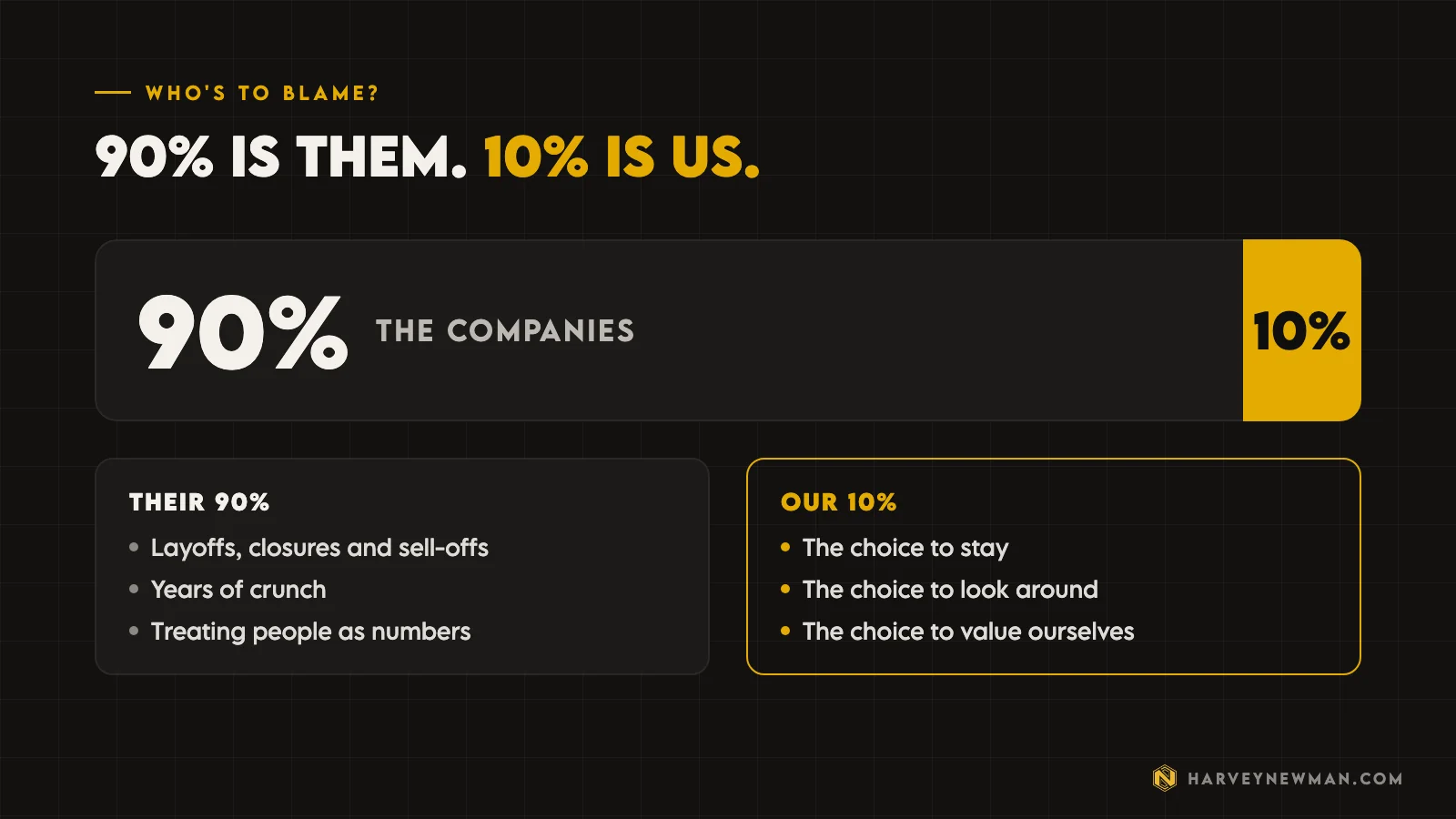
Taking accountability for the decision to stay, instead of looking around, has something to do with whether we become a sustainable industry in the long run. Only by owning our part of this mess can we learn from it and find a better future for games.
“You were smart to leave before the storm.” I wasn’t.
I’ve been in the games industry for over 20 years, mostly in AAA. Now I work in indie and help developers prop up their businesses.
A good friend of mine, Nate Thomas, asked me a question nobody had asked me in a while. What made you leave a cushy AAA job, with a great salary and bonuses, to start a YouTube channel, go independent, start your own company and consult?
That conversation stuck with me, because many people are now walking into a world where everything is uncertain, and it’s going to feel like a whirlwind. It did for me too.
What makes me sad is when people tell me I was smart to do it before the storm.
I don’t think I was that smart. I was just doing it for personal reasons.
I didn’t anticipate for a second that the industry would end up this broken.
The career ladder trap in game development
For anyone outside the industry, here’s how a games career was supposed to work, at least 10 or 15 years ago.
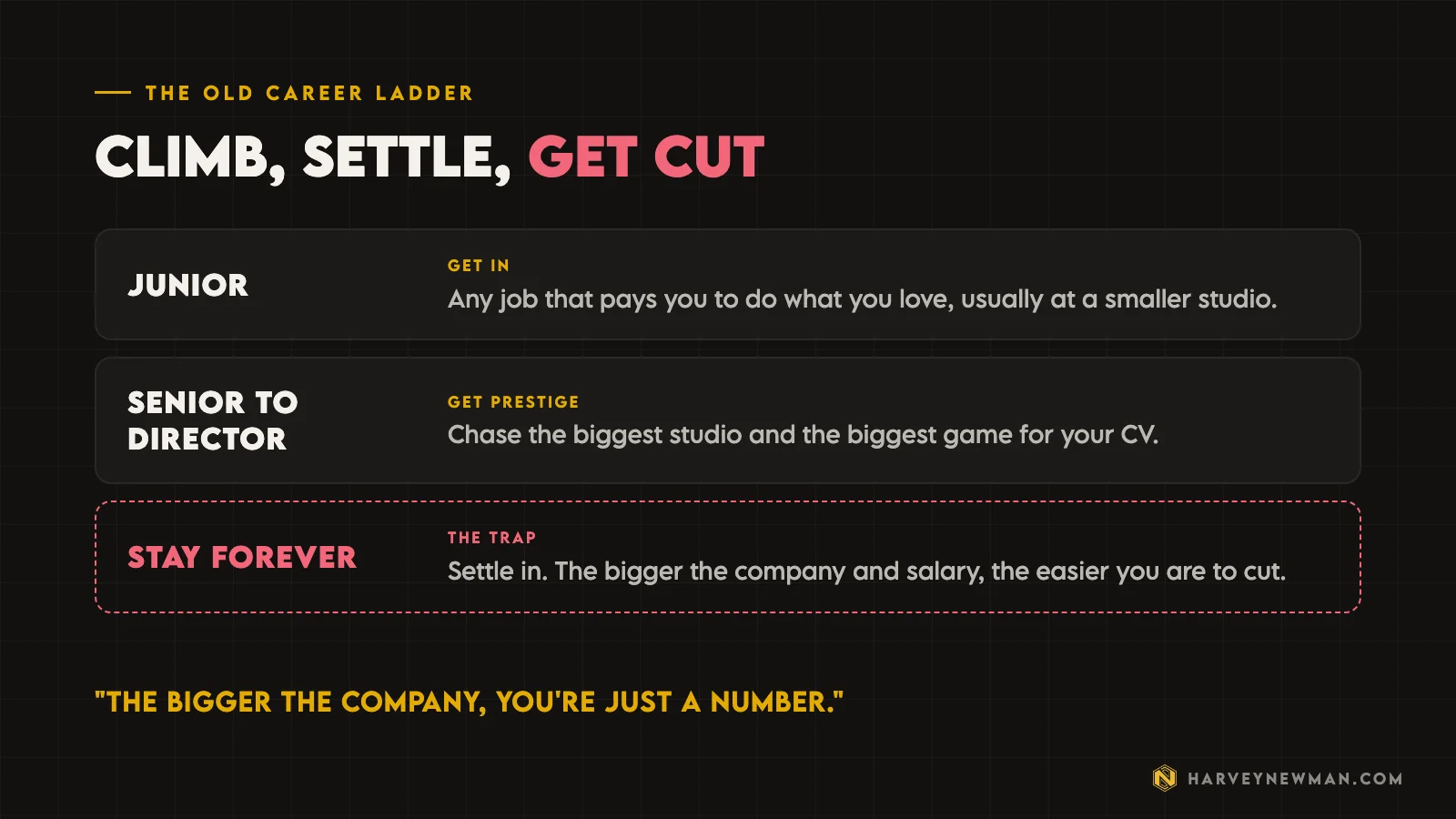
As a junior you take any job you can get. It doesn’t matter what it is, as long as you’re paid for what you love. Usually it’s a smaller company, one with less prestige, maybe one that’s been around for years without anyone knowing its name. It’s work, and you do well.
As you rank up to senior, lead and director, you start looking for prestige. You want to lead or direct a project on a certain level of game, because that looks great on your CV and opens even more doors.
That’s been the status quo. Rank up, find the best studio possible, get into a position of leadership and cement your knowledge.
Then comes the part that’s on us. Once people land at a massive, prestigious company, there’s a feeling that they want to settle there and work there forever.
Why staying too long at one studio is risky
I always felt driven by passion and by my own ambitions inside a studio. After about two years at any one studio, I’d get tired of the same project and want to move. I never understood people who stayed at one studio for 10, 15 or 20 years. I commend them for it, and there’s nothing wrong with it.
But companies, at least in my experience, deal with people as if they were numbers.
The bigger the company, you're just a number, and this is your salary.
Harvey Newman
If you have a high salary, you’re more likely to be cut, because you affect the budget in a bigger way. If you’re a junior or entry level developer, you’re cheap, so you’re easier to keep. That’s the mentality. After a few bad experiences, it was clear to me that the companies didn’t care about me. The people who cared were my team, not the company.
Why I left AAA
When Nate asked, my answer came down to two things: frustration and independence. Both were clear in my mind.
When I started my YouTube channel, I saw people outside the industry reacting to my ideas and to the knowledge I’d built up over all those years. Even though the channel was tiny, it was empowering to see that what was in my head was more valuable than I’d thought. I started to value myself differently.
For a few years I did both, YouTube and development at the same time. Then I started thinking about a future where I focus on the side where I value myself, and where people value me the way I now value me. My mind shifted massively.
That turned into consultancy, into building a company, into joining Rekindled, and into consulting for companies, including AAA, at a higher level and for bigger fees in the end.
It took a good two to three years to get back to the salary I had in the safe space.
So I’m not saying I’m doing well and they aren’t. I’m taking responsibility for my 10% too. I wrote more about that move in leaving AAA and going independent.
What experienced game developers are worth now
Here’s where I think the games industry is going, and I might be wrong: towards developers being more self-sustainable.
Most of us do this for the passion, not the money. United, I think we can negotiate better deals and do more than work for one person or one company. The aggressive things that have happened over the last 20 years, crunch included, will change, because people aren’t there just to churn out work.
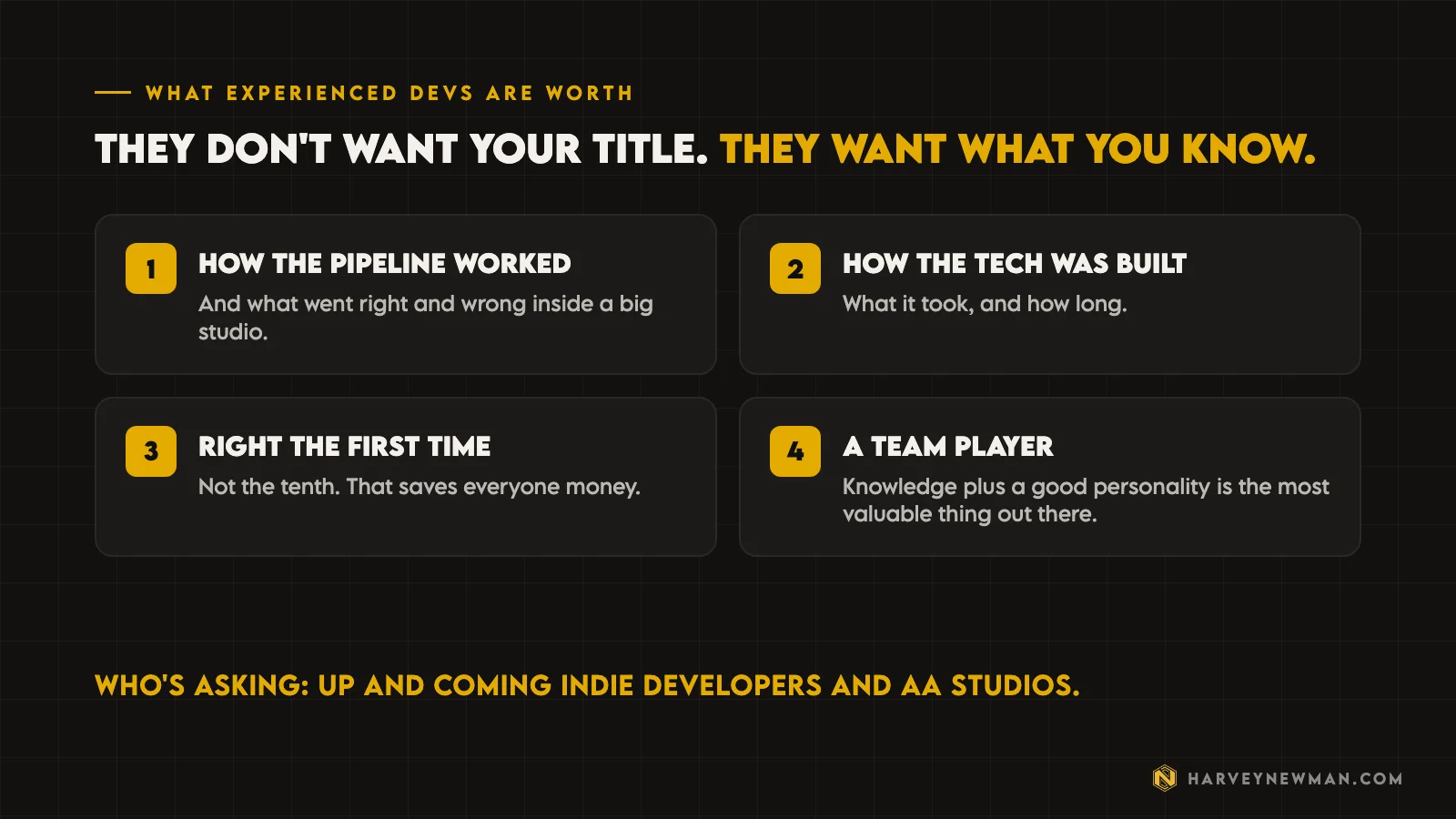
People want your knowledge. Up-and-coming indie developers and AA studios want what someone from an Xbox studio, say Ninja Theory, knows. Not because they’re a great engineer who worked on impressive tech, but because of the answers to questions like these:
- The pipelineHow did it work, and what were the positives and negatives of working that way?
- The techHow did you build it, and how long did it take?
- The first timeDoing it right the first time, not the tenth, saves everybody money.
Pair that with a good personality and being a team player, and there’s nothing more valuable out there. I can tell you from experience: people want what you have.
As soon as you start feeling empowered, all of a sudden you can do all these other things.
Harvey Newman
I couldn’t have built Animworks, joined Rekindled or run my own studio, Proxima, without the headspace of not having to ask permission to do those things.
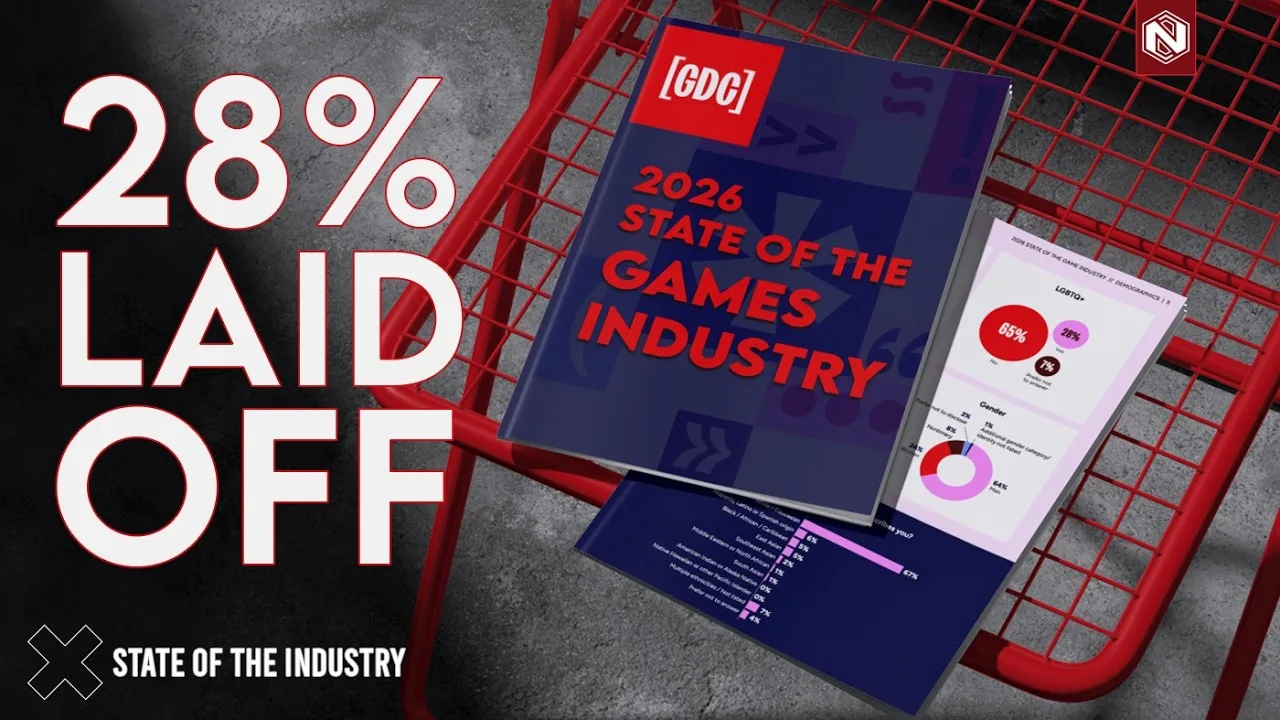
As I said in my video on the GDC 2026 State of the Game Industry report, I think this is something negative that comes for the betterment of the industry: hardship before a better future. I don’t know how long it’ll take. I’d hoped the last six months meant we were through two or three bad years. Maybe we needed to go a little longer.
What we’re doing about it
It’s easy to bang the table about how bad things are. I think we all have a responsibility to do something about it too, as much as we can.
For us, that’s Animworks, a hub for animators and game developers across games, VFX and film. It has rigs, scripts, plugins, mocap resources and books to help you build a better showreel. We’ve also launched a mentorship programme that pairs you with experienced people in the industry, some with more experience than me and some with less. Book an hour, a week or a month, and get a straight answer to “what am I doing wrong?”, on your work or on your career. I’m on there too.
We’re also building a jobs portal to connect companies with animators and developers who are looking for work. There are already spreadsheets and LinkedIn links out there, but if it helps a few more people who are ready and just want a job, it’s worth building.
If you’re earlier in your career, I wrote about the junior game developer time bomb and the back doors into studios that still work.
Where are you right now?
So I’ll leave you with a question, whether you’re a professional in this industry or someone on the outside watching all this panic.
Where are you mentally? Do you feel like there’s a future for you? Does it feel like everything is collapsing around you? Or is this an opportunity to execute the ideas you had when you worked for somebody who wouldn’t let you?
Tell me in the comments on the video.
The video
Watch the full breakdown
Questions people ask
Why is the games industry broken?
Harvey puts about 90% of it on the companies: mass layoffs, studio closures and sell-offs, years of crunch, and treating people as numbers on a budget. The remaining 10% is on developers who stayed put instead of looking around and valuing what they know.
How many people did Xbox lay off in 2026?
In July 2026 Xbox announced plans to cut about 3,200 jobs over the following year, with around half of those immediately, and four studios leaving Xbox: Compulsion Games, Double Fine, Ninja Theory and Undead Labs.
Is it worth leaving a AAA studio?
Harvey left AAA for personal reasons, frustration and a wish for independence, not because he saw the downturn coming. It took two to three years to get back to his old salary, but he now values his own knowledge more and has more control over his work.
Why do senior game developers get laid off first?
At big companies people are often treated as numbers and salaries. A high salary hits the budget harder, so senior staff can be more exposed than cheaper junior or entry level staff.
What can game developers do about layoffs?
Own your part. Don't settle forever at one company, keep looking around, and value what you know. Indie and AA studios want the knowledge experienced developers carry, and freelancing, co-dev and consulting spread the risk across more than one employer.
And remember,
there are no shortcuts for animation.
 Stay well, stay safe,Harvey NewmanBook a free call →
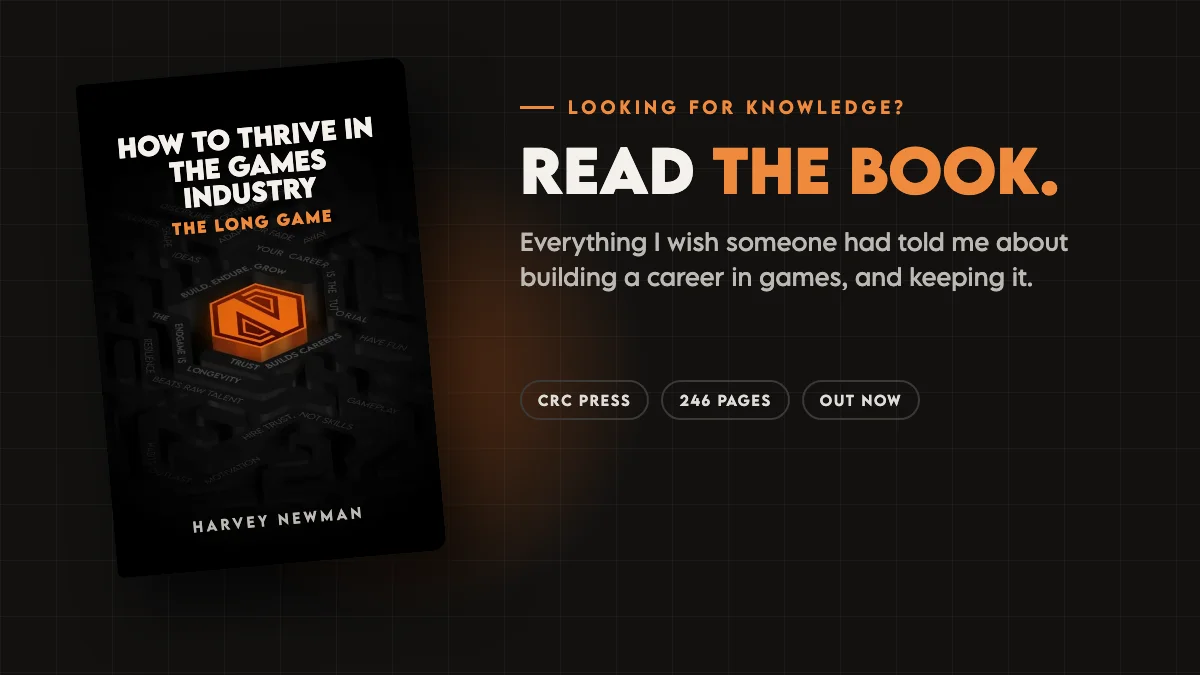 Looking for knowledge?How to Thrive in the Games Industry: The Long GameMy book on building a career in games and keeping it. CRC Press, 246 pages.Get the book →
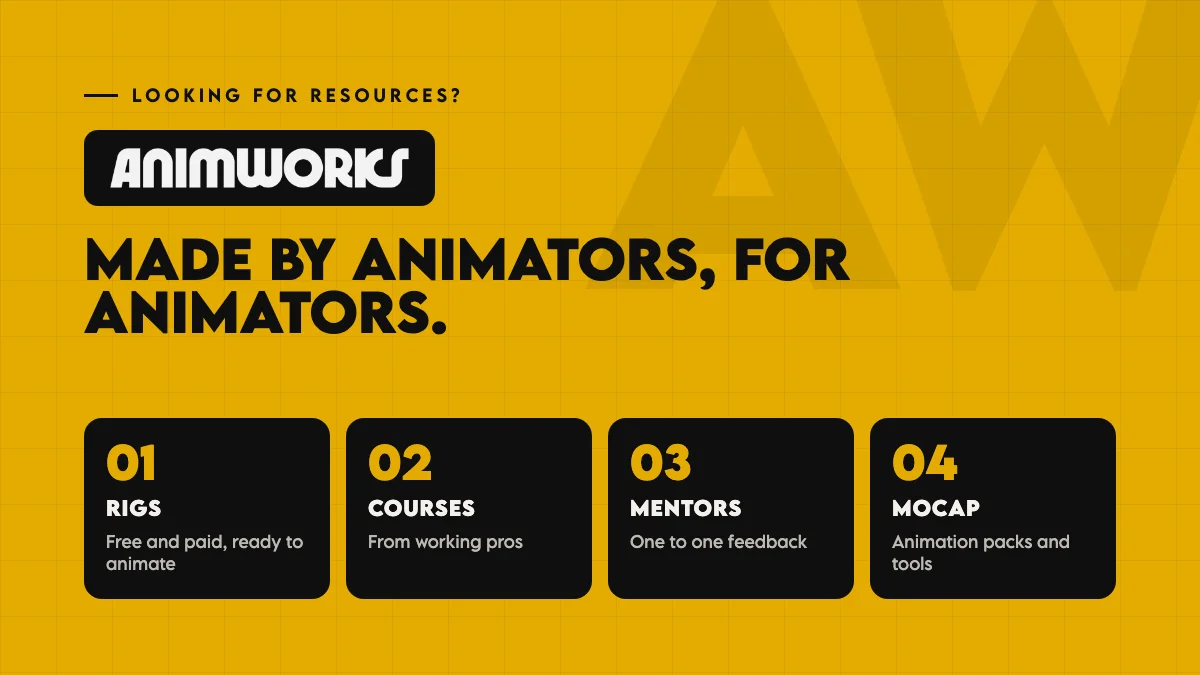 Looking for resources?Rigs, courses and mentors on AnimworksFree and paid rigs, courses from working pros, one to one mentoring and mocap packs.Visit anim.works →
 Leaving AAA and Going Independent: How I Did It After 20 Years2 Oct 2026
 GDC 2026 State of the Game Industry: The Truth About Layoffs15 May 2026
 Xbox Layoffs Cut 4 Studios. Why They Might Be Better Off Now31 Jul 2026
 The Junior Game Developer Time Bomb, and the Back Doors Still Open17 Jul 2026