
About Harvey10 min read20 min video
10 islands. Half a million people. One World Cup debut.
Harvey Newman: How My Cape Verdean Roots Shaped My Career
Key takeaways
- Cabo Verde is 10 islands and about half a million people, with far more Cape Verdeans living abroad, and it still punches above its weight.
- Harvey Newman calls his path a string of happy accidents: born in Portugal, raised by strangers, broke in London, and a chance meeting on a train that led to QA.
- QA at Microsoft and then SEGA was his first taste of the games industry, but he saw it as the edge of the industry, not the part that builds the game.
- A mentor, Jason Ryan, gave him free feedback for years and told him any opportunity is a good one. That advice got him his first games job at 29.
- From 29 to 39 he went from junior animator to director. His view: success is half happy accidents, half tenacity, decisions and sacrifice.
I had to make this one, because I’m proud of my roots. I’m Harvey Newman, and my family is from Cape Verde, or Cabo Verde. I recorded the video the day before Cabo Verde played its first ever game at a World Cup, against Spain.
Usually I talk about game development and animation. This one is personal, a way to reintroduce myself to everyone who has subscribed in the last couple of years. So here is who I am behind the scenes, and how a string of happy accidents, and plenty of stubbornness, took me from a kid with no family around him to a director in AAA games.
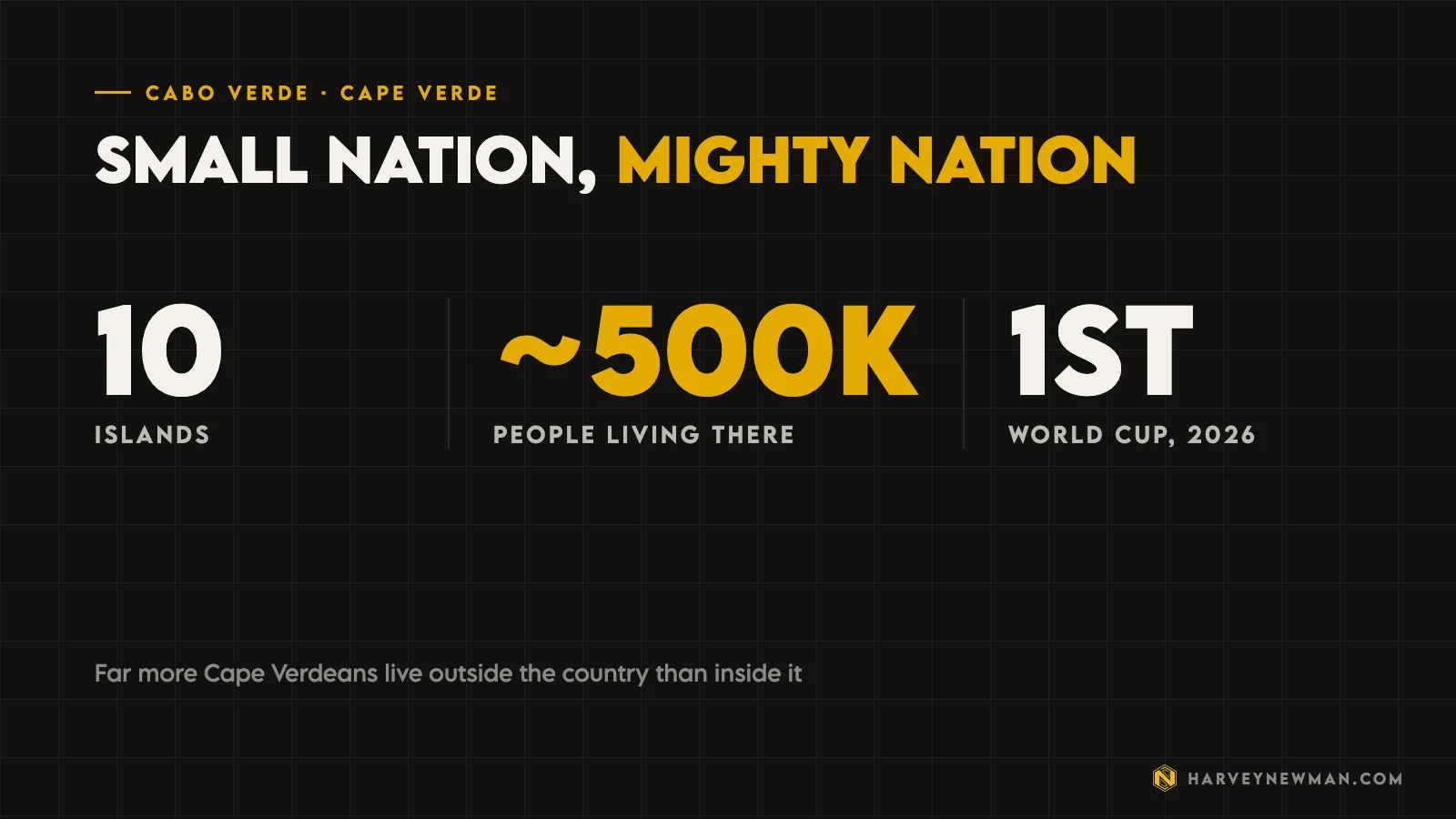
Cabo Verde: a small nation, but a mighty one
Cabo Verde is 10 islands in the middle of the Atlantic, just off the west coast of Africa. About half a million people live there, and far more Cape Verdeans live outside the country than in it.
It’s so small that plenty of world maps forget it. Every time my family and I see one, we check. Did they put Cabo Verde on the map?
And yet we constantly punch above our weight. Getting to the World Cup isn’t just a football story to me. It’s the whole story. Most Cape Verdeans have this kind of story, where you’re David fighting Goliath, and anyone from there who has made it had to face real adversity to get there.
It’s a small nation, but it’s a mighty nation.
Because of my family I grew up speaking Creole, with the music of Cabo Verde and its people. I grew up dancing kizomba. The culture runs deep: the food, the dances, the music. The one thing everyone takes home from Cabo Verde is the people’s happiness. Everybody is warm, everybody has a smile, and even though it’s poor, everybody helps each other.
Harvey Newman’s happy accidents
My journey has been a string of happy accidents, along with talent, tenacity and believing in a dream.
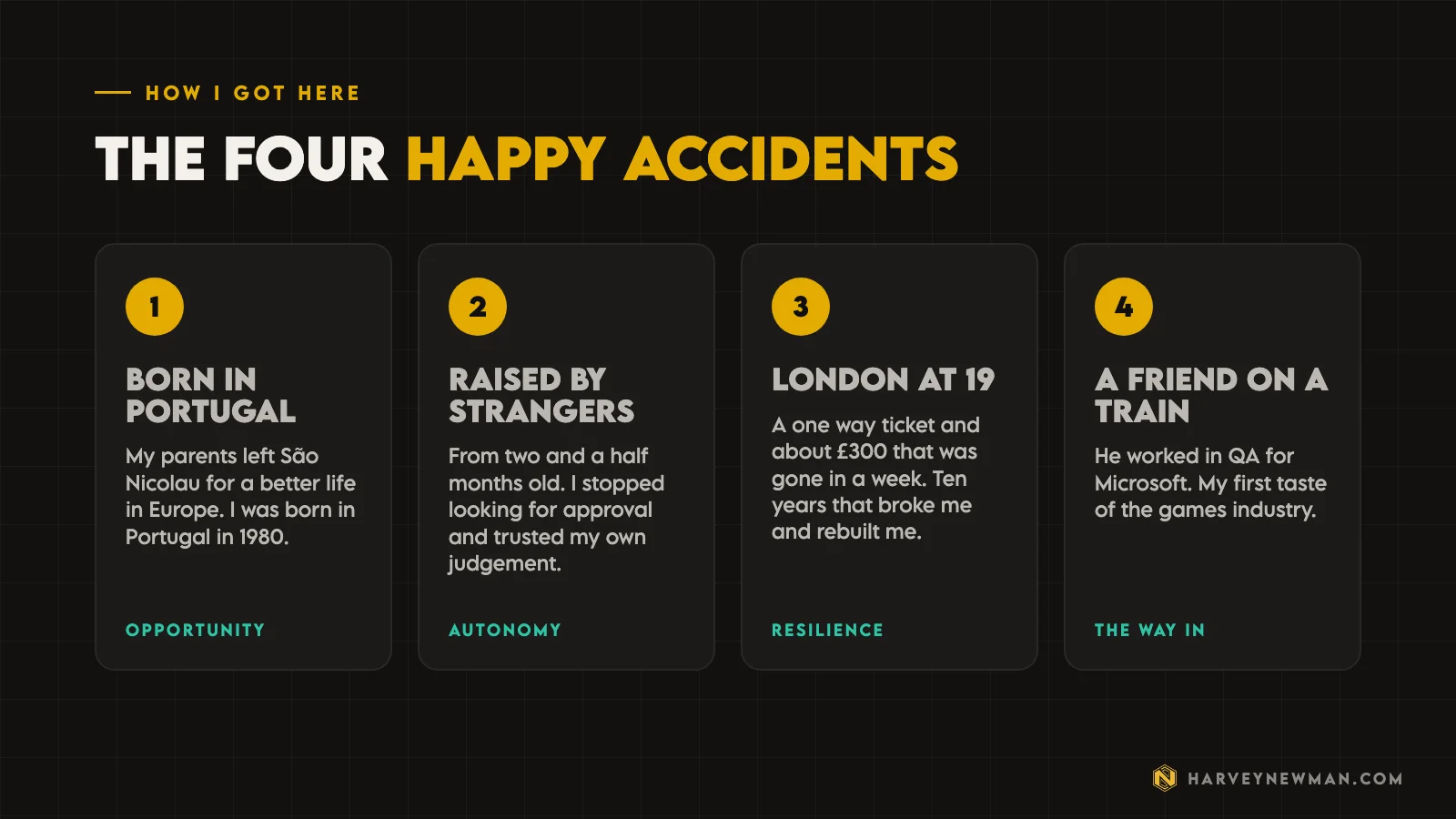
- Born in PortugalMy parents came from São Nicolau, one of the 10 islands, to Europe for a better life. I was born in Portugal in 1980 and spent about 19 years there, with a stint in Spain.
- Raised by strangersIt taught me to stop looking for other people's approval and to trust my own judgement.
- London at 19A one way ticket, no money, and ten years that broke me and built me back up.
- A friend on a trainHe worked in QA for Microsoft, and that was my first way into the games industry.
Raised by strangers
This is the hardest part to talk about. My mum had me, my father wasn’t there, and when I was about two and a half months old I was given to a lady to be taken care of. She wasn’t my mum and she wasn’t family. I lived there for about 10 years, and it was not the best of times. I won’t go into details.
After that I went from house to house, like a foster kid, living with strangers. When you live with a family you’re not part of, you get a feeling of dismissal, like they don’t care about you that much. So you stop looking for approval and start looking inwards: I think this is good, and that’s enough.
That helped me a ton. It made me autonomous. If I thought something was good enough, hopefully others would too, without wondering what my mum or dad would think. I started illustrating a lot at that time and wanted to be an illustrator. But Portugal became too small for the opportunities I wanted.
Moving to London at 19 with a one way ticket
At 19 I moved to London. For the first two years it felt magical. I could see people who looked like me working as lawyers and doctors. To me there was no ceiling.
I came on a one way ticket with maybe £300, and it was gone in about a week once I’d paid the deposit on a room. Then I worked one bad job after another: waiter, coffee shops, sales assistant, silver service for rich people. The jobs weren’t the problem. The places I worked treated us badly.
I spent a good 10 years in London, and it broke me many times, psychologically, physically and emotionally. Each time I had to pick myself up and be a little stronger. In all that time I wasn’t animating or doing anything artistic. I was building muscle on those three fronts, trying to withstand the pressures of life without becoming a negative person. I’m always thankful to London. It made me who I am.
How I got into the games industry through QA
While I was grinding, I met a good friend on a train. He told me he worked in QA. I didn’t even know what QA was. Quality assurance, for Microsoft.
“So you just play games all day?”
“Yeah, pretty much.”
After 8 to 12 hour shifts in coffee shops or serving tables, that sounded like a dream. One thing led to another: they gave me a week to test me out, they liked me, and I ended up doing it for six months. It was my first taste of the industry, and I’m forever thankful, because without it I wouldn’t be where I am.
Then I moved to a full time QA job at SEGA, testing games like Worms Forts, OutRun and Total War. I was a QA tester on the first Football Manager that ever came out, and I still have one of the master discs at home.
But I realised that QA, even though it’s part of the games industry, sits on the edge of it. You aren’t building any feature of the game. You’re helping find the problems with it. If you’re looking for your own way in today, I wrote about where the game dev jobs went and how to get them.
Studying animation while working full time
Because I was good at illustrating, I applied to a West London university to study animation. I got a tiny bank loan for books, but I still had to work. So I worked a full time job, studied full time, and did QA whenever I could to pay the bills.
I wouldn’t wish it on anybody. Work threatened to fire you because you weren’t doing as much as everyone else, and university wasn’t going as well as you knew it could. You end up dwelling in your own head.
Towards the end of the course I realised I wasn’t learning much about animation itself. The dream of going straight to Pixar was fading fast. So when I finished, I went all in on animation.
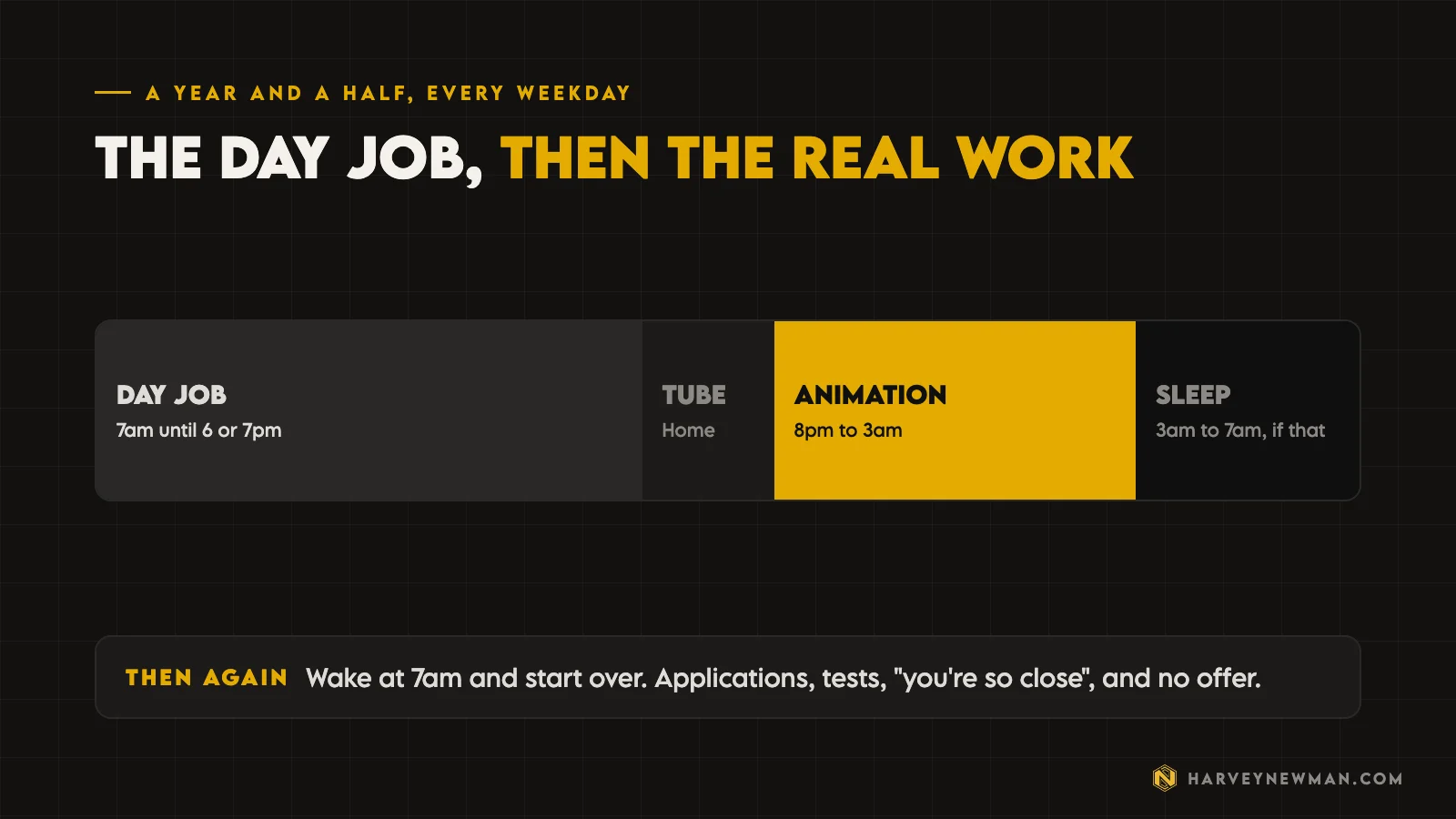
I had a full time job at a company called Arvato. The people were great, but it wasn’t what I wanted to do. I’d leave at 6 or 7pm, spend a couple of hours getting home on the Underground, eat quickly, then work on my animation from 8pm to about 3am. Three or four hours of sleep, up at 7am, and do it again. For at least a year and a half.
Nothing was working. A couple of studios gave me two or three tests each, told me I was so close and that they were 100% thinking about hiring me, and then didn’t. I was exhausted and about to throw in the towel.
Finding a mentor: Jason Ryan
Then I found a mentor called Jason Ryan. He was in the US, at Disney and then DreamWorks. Jason saw something in my illustrations that told him I had enough talent for animation, and he believed in me.
He gave me feedback on my shots for free, in his spare time. Coming from a background where nobody cared that much, where I had almost raised myself, having someone across the pond who didn’t know me care whether I did well meant everything.
Without Jason, I would 100% have thrown in the towel.
Harvey Newman
We worked together for about another two years. I was exhausted, but as long as Jason was giving me his time, I was going to be there for him too. That kept me going.
Eventually I asked him by email: is any opportunity a good one, or should I hold out for the studio I dream of? For me that was Pixar, DreamWorks or Blue Sky. His answer:
Any opportunity is good. As long as they give you a job, you’ll get the experience, and eventually you fall into a place that you want.
So I stopped being picky and started applying to games, which back then weren’t as prestigious as they are now.
Is it too late to start a career in animation at 29?
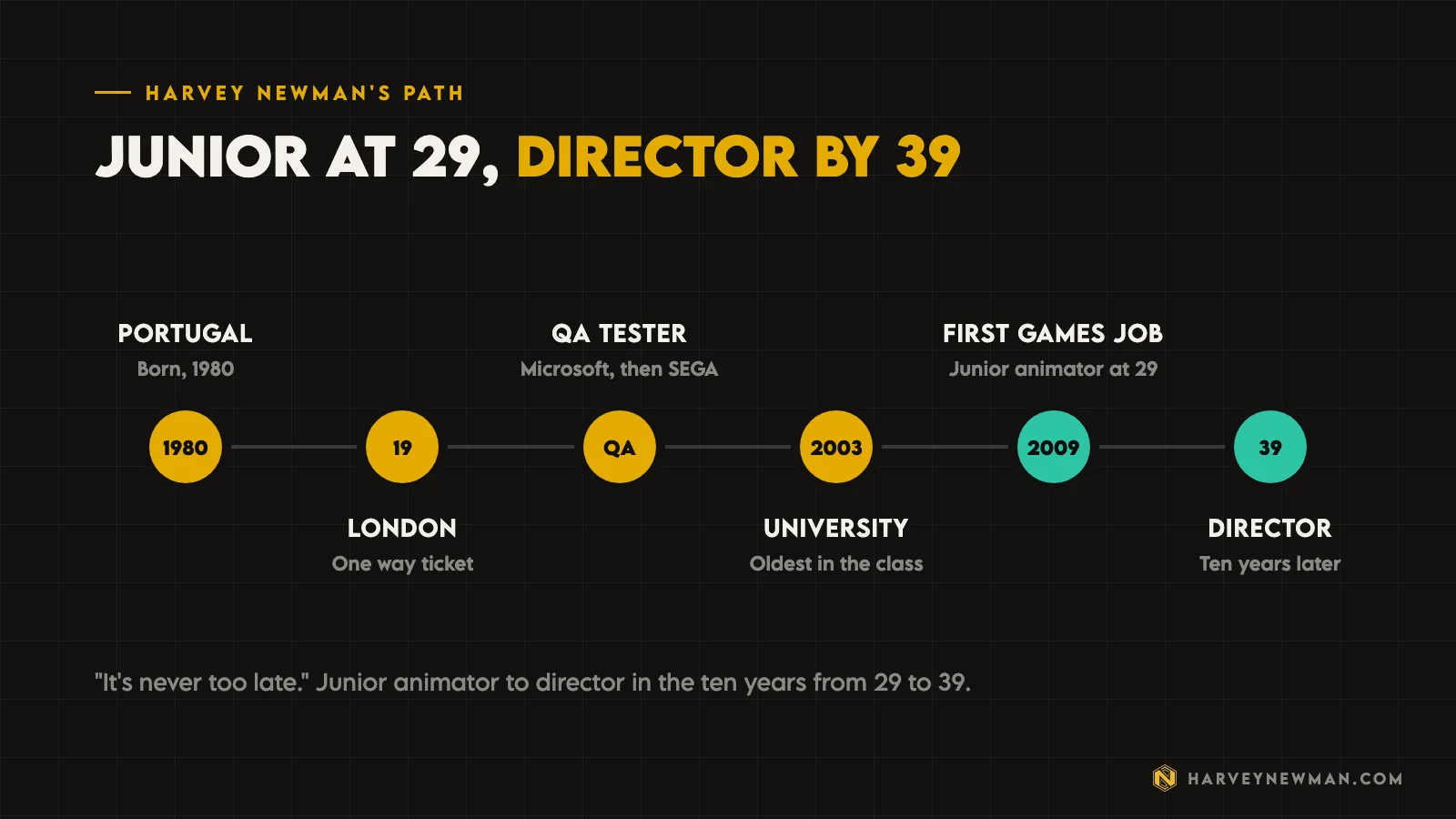
I got my first job in games in 2009. I was 29, and I was sure I was way too old. I had already been the oldest student at university when I started in 2003. Now I was about to turn 30. What was I going to do with my career?
I’m 45 now, and that sounds ridiculous. But that’s exactly what I thought. If you’re in your 30s or 40s and reading this, it’s never too late. One of my mentors started their career close to 50 and is still thriving.
That fear of being too late made me go hard for the next 10 years. From 29 to 39 I went from junior animator to director. You can do a lot in a short time if you want it badly enough and have the tenacity to keep going. More on that first rung in the reality of being an animator.
Luck, tenacity and sacrifice
When we look at someone successful, we see the end result. Then we see the luck: they must have been lucky, or they must have been talented.
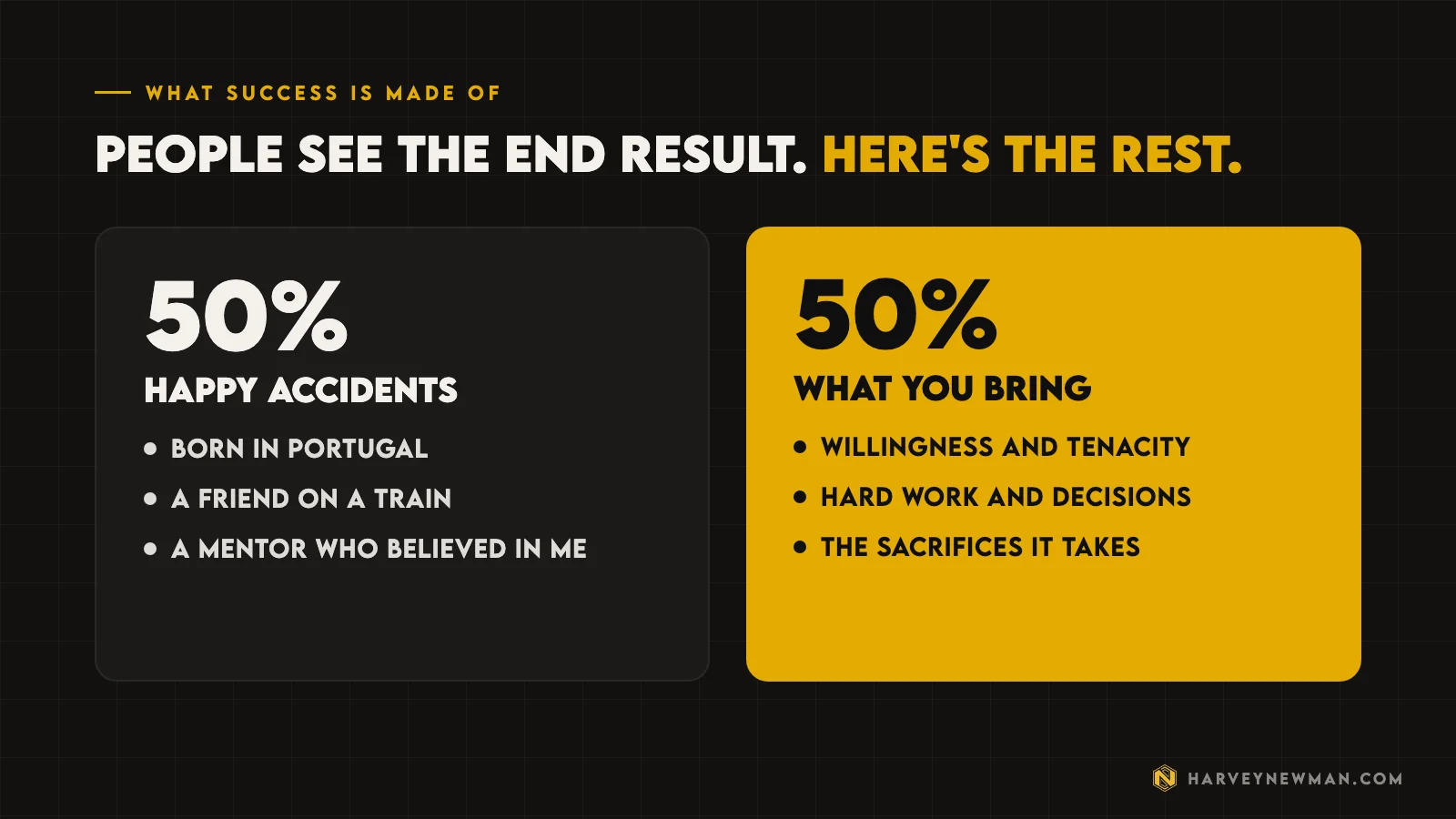
I don’t think most people get there like that. I think half of it is happy accidents strung together, the ones that otherwise wouldn’t have got you there. The other half is willingness, tenacity, hard work and your decisions, and how well you put them together. Everyone reading this can tweak those things to make the most of their situation.
I went from a baby without his parents, raised by strangers all over the place, to a reality where I’m lucky enough to have a family, two beautiful daughters, and to be happy both at work and at home. I had to make that reality happen. It wouldn’t exist without everything before it, and it was hard. You have to fight harder than other people.
You can shape your reality, as long as you're willing to make the sacrifices.
Harvey Newman
After 25 years, that’s what I’ve learnt most. What I think most people are missing is the sacrifice part. Sometimes it’s working for free because you know you’ll get the credit or the experience. Sometimes it’s learning from others. Sometimes it’s going through the hardship.
I’m still scared of going back to the London times, broke with next to nothing. Because I’m so scared of it, I work hard to make sure I never do. Same with my daughters. I was put through a lot as a child, without parents, and I don’t want that for them. I want to shape their reality so they grow up full of love and unity, with the things I missed.
Seeing opportunities where others don’t
When I first went looking for a job in games, it felt like Neverland. I loved games, but where were the game developers? How were games even made? There was no behind the scenes back then. It was just games. I managed to sneak in, got a chance, and made the most of it.
I’ve done the same with everything since: Animworks, my studio Proxima, this channel. It’s about seeing opportunities where others don’t, making the most of them, and believing it’s the right thing. If you want to know how I’m doing that now outside AAA, read why I left AAA to go independent, or see more about me.
Take Cabo Verde as the example. Ten small islands with half a million people. If they can do it, I think you can do it. If I can do it, you can too. There are always opportunities. It depends on how you see them.
I go into far more detail in my book, How to Thrive in the Games Industry. And if you’re Cape Verdean and want to be a game developer or an animator, get in touch. I’d love to help, and that goes for everyone else too, through my consultancy or just a message.
I’m curious: did you know about Cape Verde before the World Cup? Have you been, or do you know someone from there? Tell me in the comments on the video.
The video
Watch the full breakdown
Questions people ask
Who is Harvey Newman?
Harvey Newman is an animation and game director with over 20 years in games. His parents are from São Nicolau in Cabo Verde, he was born in Portugal in 1980, moved to London at 19, and got his first games job as a junior animator in 2009.
Is Harvey Newman Cape Verdean?
Yes. His parents came from São Nicolau, one of Cabo Verde's 10 islands, and moved to Europe for a better life. He grew up with Cape Verdean music, food, dance and Creole, and calls Cabo Verde the place his roots are from.
How did Harvey Newman get into the games industry?
Through QA. A friend he met on a train worked in quality assurance for Microsoft. That led to a trial week, six months of QA there, then a full time QA job at SEGA, before he studied animation and spent years practising at night.
Is it too late to become an animator at 30?
Harvey got his first games job at 29, thought he was too old, and went from junior animator to director by 39. One of his mentors started a career close to 50 and is still thriving. His answer is that it is never too late.
Who mentored Harvey Newman?
Jason Ryan, an animator at Disney and then DreamWorks, saw something in Harvey's illustrations and gave him free feedback on his shots for about two years. Without that support, Harvey says he would have given up.
And remember,
there are no shortcuts for animation.
 Stay well, stay safe,Harvey NewmanBook a free call →
 Looking for knowledge?How to Thrive in the Games Industry: The Long GameMy book on building a career in games and keeping it. CRC Press, 246 pages.Get the book →
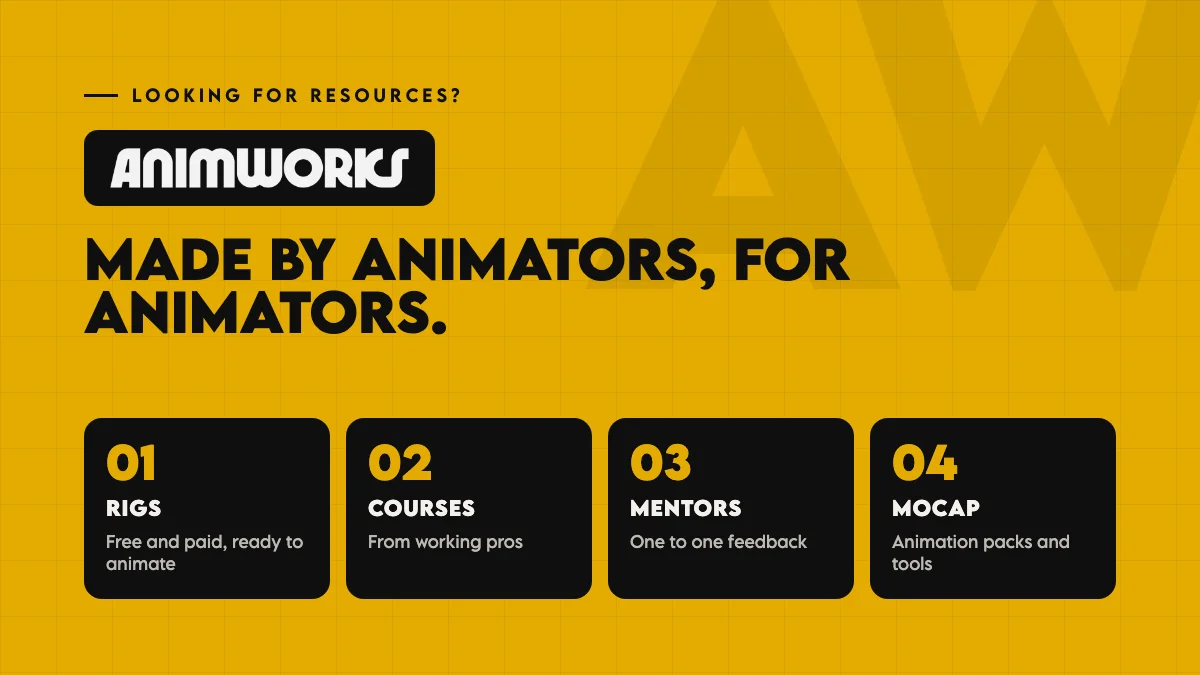 Looking for resources?Rigs, courses and mentors on AnimworksFree and paid rigs, courses from working pros, one to one mentoring and mocap packs.Visit anim.works →
 The Reality of Being an Animator in 2026: How an Animation Career Has Changed16 Oct 2026
 The Junior Game Developer Time Bomb, and the Back Doors Still Open17 Jul 2026
 Where the Game Dev Jobs Went, and How to Get Them18 Sept 2026
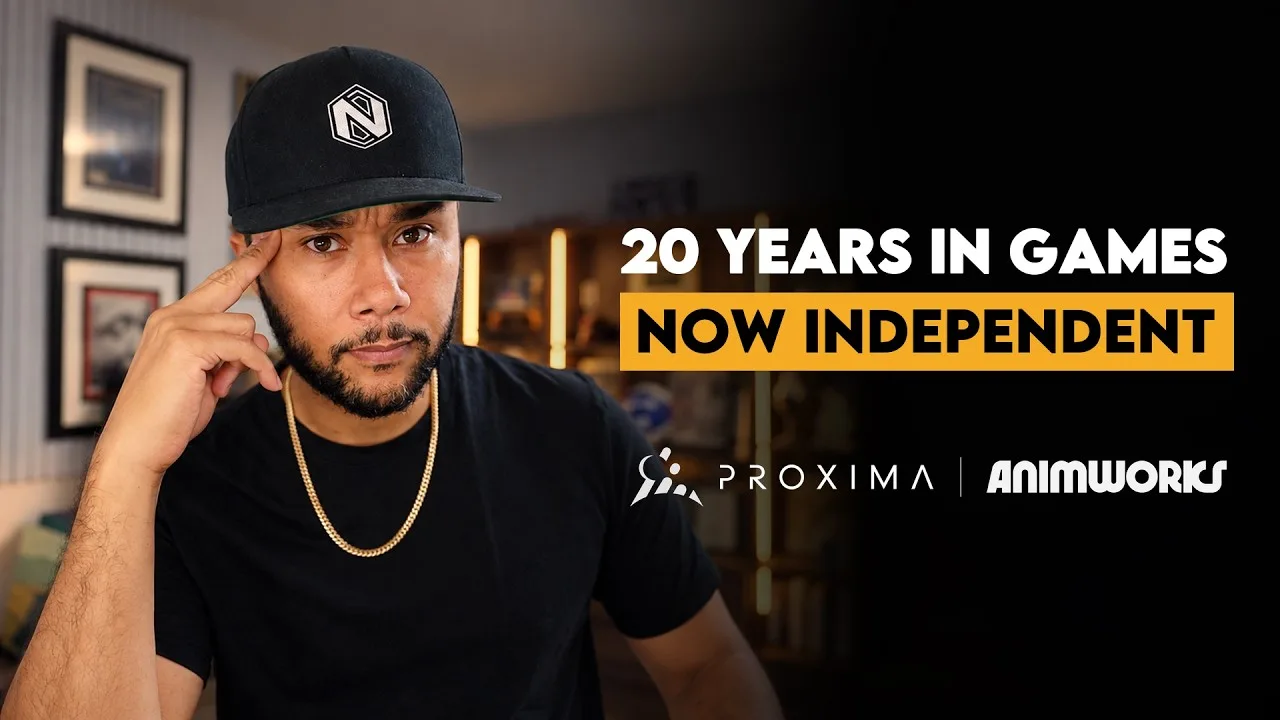 Leaving AAA and Going Independent: How I Did It After 20 Years2 Oct 2026